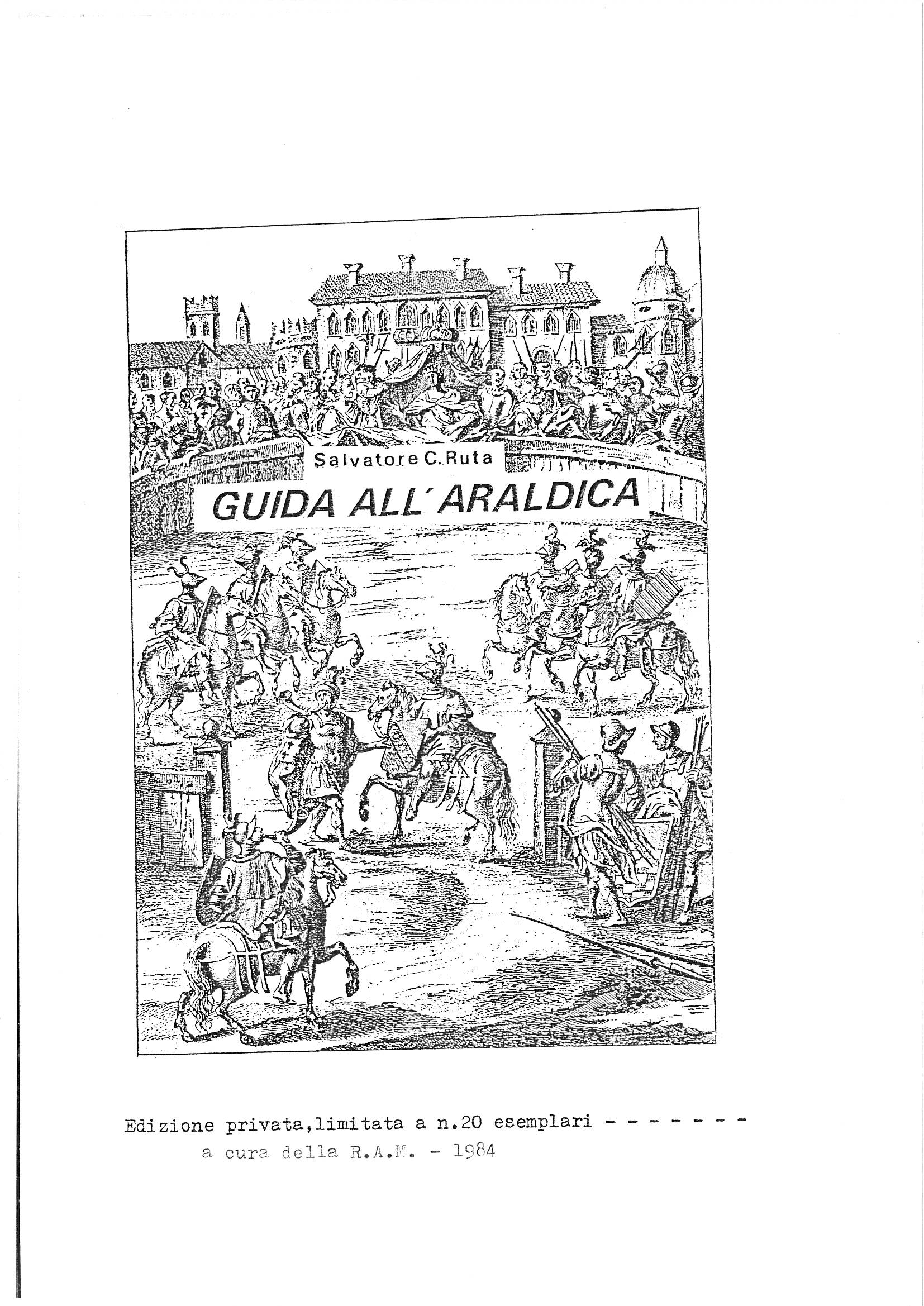
Salvatore C. Ruta
GUIDA ALL'ARALDICA
Edizione privata,limitata a n.20 esemplari — — — — — — —
a cura della R.A.M. - 1984
---
Salvatore C. Ruta
GUIDE TO HERALDRY
Private edition, limited to 20 copies — — — — — — —
under the care of R.A.M.
- 3 -
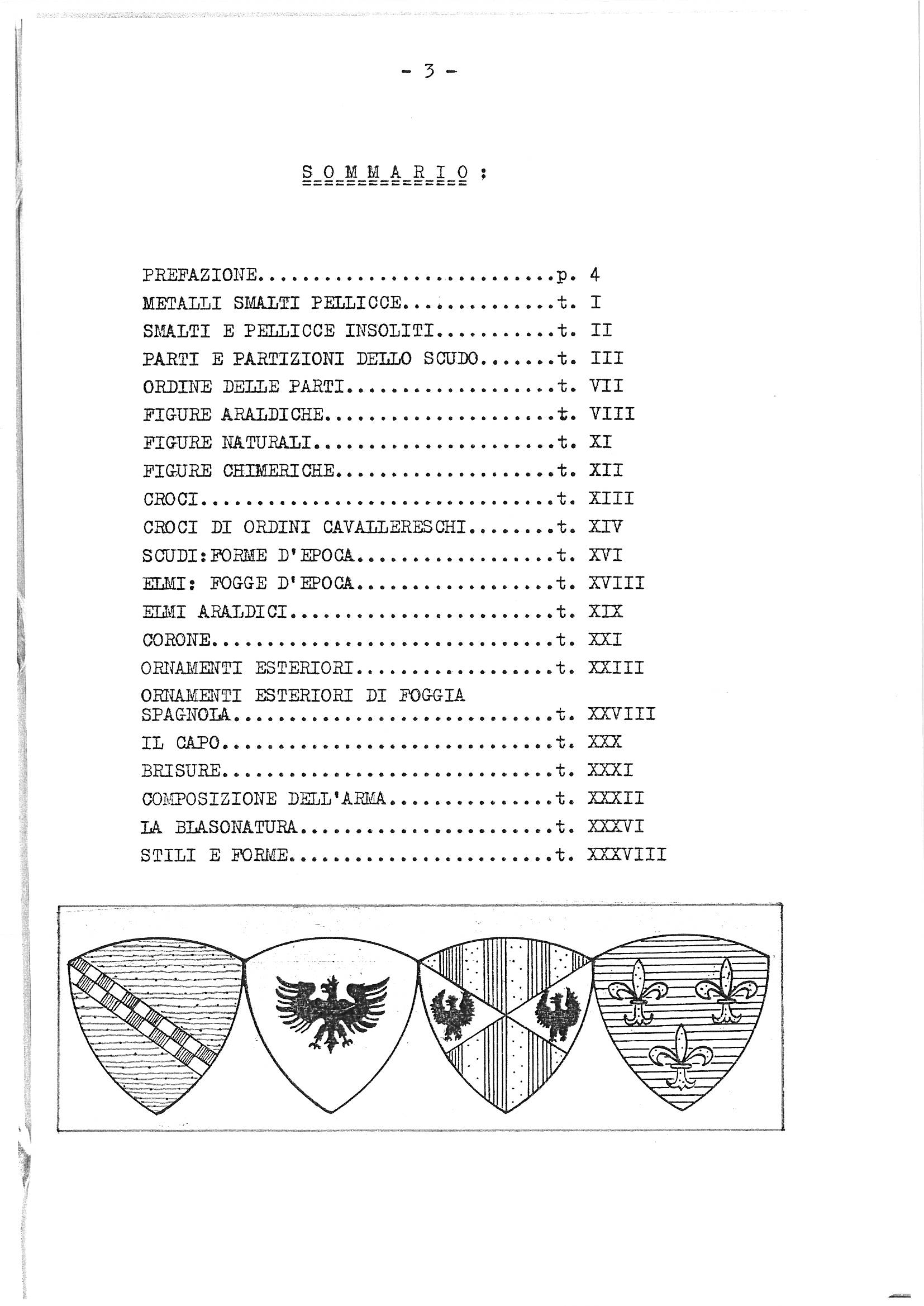
SOMMARIO:
PREFAZIONE...............................p. 4
METALLI SMALTI PELLICCE.................p. I
SMALTI E PELLICCE INSOLITI..............p. II
PARTI E PARTIZIONI DELLO SCUDO.........p. III
ORDINE DELLE PARTI......................p. VII
FIGURE ARALDICHE.........................p. VIII
FIGURE NATURALI..........................p. XI
FIGURE CHIMERICHE........................p. XII
CROCI....................................p. XIII
CROCI DI ORDINI CAVALLERESCHI...........p. XIV
SCUDI: FORME D'EPOCA.....................p. XVI
ELMI: FOGGE D'EPOCA......................p. XVIII
ELMI ARALDICI............................p. XIX
CORONE...................................p. XXI
ORNAMENTI ESTERIORI......................p. XXIII
ORNAMENTI ESTERIORI DI FOGGIA
SPAGNOLA.................................p. XXVIII
IL CAPO...................................p. XXX
BRISURE..................................p. XXXI
COMPOSIZIONE DELL'ARMA...................p. XXXII
LA BLASONATURA............................p. XXXVI
STILI E FORME............................p. XXXVIII
- 3 -
CONTENTS:
PREFACE...............................p. 4
METALS, TINCTURES AND FURS..............p. I
UNUSUAL TINCTURES AND FURS..............p. II
DIVISIONS AND PARTITIONS OF THE SHIELD.p. III
ORDER OF THE PARTS......................p. VII
HERALDIC FIGURES.........................p. VIII
NATURAL FIGURES..........................p. XI
CHIMERIC FIGURES.........................p. XII
CROSSES.................................p. XIII
CROSSES OF CHIVALRIC ORDERS.............p. XIV
SHIELDS: FORMS OF THE PERIOD............p. XVI
HELMS: FORMS OF THE PERIOD..............p. XVIII
HERALDIC HELMS..........................p. XIX
CROWNS..................................p. XXI
EXTERIOR ORNAMENTS.......................p. XXIII
EXTERIOR ORNAMENTS IN SPANISH
FASHION.................................p. XXVIII
THE CHIEF...............................p. XXX
MARKS OF CADENCY.........................p. XXXI
COMPOSITION OF THE COAT OF ARMS.........p. XXXII
BLAZONRY................................p. XXXVI
STYLES AND FORMS.........................p. XXXVIII
- 4 -
PREFAZIONE
*H*o composta -letteralmente- questa "Guida all'Araldica"
per quelli tra i miei amici ai quali piacciono le cose po_
co o punto utili.Specialmente se rimandano a tempi che di_
già quando viveva Miguel de Cervantes erano considerati
con benevola ironia. Stemmi,corone,un gergo da iniziati..
alle soglie del 2000,mi si dirà. Non discuto l'anacroni_
smo,difendo però il diritto alla ricerca di quanto attie_
ne alle nostre radici,alla nostra tradizione,sia famiglia_
re che patria.
La Guida fornisce i rudimenti,anche e soprattutto,pra_
tici dell'Araldica,scienza ausiliaria della storia,ma si
dà dei limiti,al di fuori dei quali la sua praticità di_
verrebbe a dir poco evanescente.
Se l'araldica in Occidente ha dei caratteri comuni,ogni
Paese le dà la sua particolare impronta,una segnatura che
non sfugge all'esperto:così vi è un'araldica francese,una
inglese,una tedesca,spagnola,. Ve n'è una che si possa dir
Italiana?
L'unità d'Italia sotto la dinastia sabauda ha portato
alla formulazione dei 'Massimari' della Consulta Araldica
del Regno con i quali si è unificata,per quanto possibile,
la legislazione nobiliare degli scomparsi Stati italiani.
La Consulta Araldica ha unificato altresì le norme che re_
gono l'araldica italiana.
Con ciò è dimostrato che vi è,in effetti,un'araldica
italiana? Basta sfogliare un Libro d'Oro della Nobiltà Ita_
liana ed osservare gli stemmi riproduttivi per esser col_
ti dal dubbio. La tradizione ed il conservatorismo della
nobiltà sono stati più forti delle leggi e dei regolamen_
ti,che a loro volta l'hanno avuta vinta in materia di ti_
toli. Negli stemmi di cui parliamo si legge sotto quale
influenza sono stati creati:è storia delle dinastie che
---
- 4 -
PREFACE
*I* have composed—literally—this "Guide to Heraldry" for those among my friends who enjoy things of little or no practical use. Especially if they refer back to times that were already regarded with benevolent irony when Miguel de Cervantes was alive. Coats of arms, crowns, an insider's jargon... on the threshold of the year 2000, I shall be told. I do not dispute the anachronism, but I defend the right to research all that pertains to our roots, to our tradition, whether familial or national.
The Guide provides the rudiments, indeed and above all the practical ones, of Heraldry, an auxiliary science of history, but it sets itself limits, beyond which its practical utility would become, to say the least, evanescent.
If heraldry in the West has common characteristics, each Country gives it its own particular imprint, a signature that does not escape the expert's notice: thus there is a French heraldry, an English one, a German, Spanish one, and so forth. Is there one that may be called Italian?
The unification of Italy under the Sabauda dynasty led to the formulation of the 'Maxima' of the Heraldic Consultancy of the Kingdom, by means of which the noble legislation of the defunct Italian States was unified, as far as possible. The Heraldic Consultancy also unified the norms governing Italian heraldry.
Is it thus demonstrated that there is, in effect, an Italian heraldry? One need merely leaf through a Golden Book of Italian Nobility and observe the reproduced coats of arms to be struck by doubt. The tradition and conservatism of the nobility proved stronger than the laws and regulations, which in turn prevailed in matters of titles. In the coats of arms of which we speak, one may read under what influence they were created: it is the history of the dynasties that
- 5 -
regnarono nelle varie regioni d'Italia. E non sempre si
trattava -come ben sappiamo- di dinastie italiane. Fra
Impero e Comuni,Signorie e Principati,Sovrani stranieri
e Pontefici,quale impronta 'italiana' ebbe mai l'araldi_
ca nostrana?
Alla luce di queste considerazione,poichè ho dedicato
questa guida ai miei amici siciliani come me,ho dato in_
dicazioni di un'araldica di timbro siciliano,che,poi è
in sostanza spagnolo. Dal XIII al XVIII la Sicilia fu sot_
to dinasti spagnoli e la nobiltà siciliana in buona par_
te è di origine spagnola,sia per sangue che per titoli.
Ne consegue che anche gli stemmi hanno l'impronta ispa_
nica,il che è riscontrabile negli stemmi che fregiano gli
antichi palazzi e i cimiteri dell'Isola.
Le illustrazioni sono mie in piccola parte,la maggior
parte le devo all'artista-araldista C.A. von Volbort col
quale fui per lunghi anni in corrispondenza e all'arti_
sta-araldista H.Child. Poche altre sono di anonimi. Ad
essi la mia,la nostra,gratitudine per averci dato esempi
di corretta arte araldica.
Messina,24.2.1984
S.C.R.
---
- 5 -
reigned in the various regions of Italy. And not always were these—as we well know—Italian dynasties. Between Empire and City-States, Lordships and Principalities, Foreign Sovereigns and Pontiffs, what 'Italian' character did our heraldry ever possess?
In light of these considerations, since I have dedicated this guide to my Sicilian friends like myself, I have provided indications of a heraldry of Sicilian character, which is in substance Spanish. From the thirteenth to the eighteenth century Sicily was under Spanish dynasties and Sicilian nobility in large part is of Spanish origin, both by blood and by titles. It follows that the arms too bear the Hispanic imprint, which is evident in the arms that adorn the ancient palaces and cemeteries of the Island.
The illustrations are mine only in small part; the greater part I owe to the heraldic artist C.A. von Volbort with whom I was in correspondence for many years and to the heraldic artist H. Child. A few others are by anonymous artists. To them my gratitude, our gratitude, for having provided us with examples of correct heraldic art.
Messina, 24.2.1984
S.C.R.
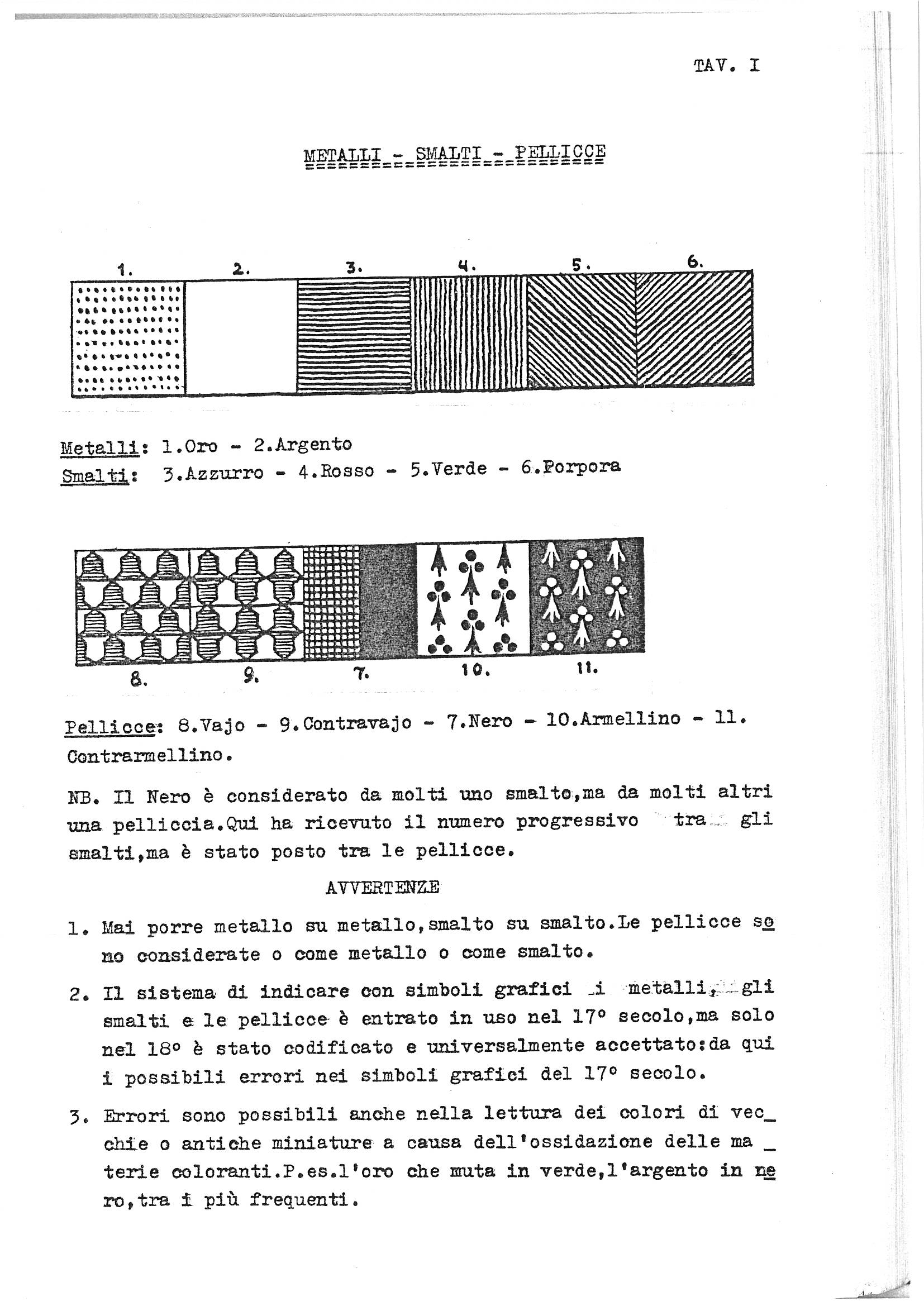
TAV. I
METALLI – SMALTI – PELLICCE
Metalli: 1.Oro – 2.Argento
Smalti: 3.Azzurro – 4.Rosso – 5.Verde – 6.Porpora
Pellicce: 8.Vajo – 9.Contravajo – 7.Nero – 10.Armellino – 11.
Contrarmellino.
NB. Il Nero è considerato da molti uno smalto,ma da molti altri
una pelliccia.Qui ha ricevuto il numero progressivo tra gli
smalti,ma è stato posto tra le pellicce.
AVVERTENZE
1. Mai porre metallo su metallo,smalto su smalto.Le pellicce so_
no considerate o come metallo o come smalto.
2. Il sistema di indicare con simboli grafici i metalli, gli
smalti e le pellicce è entrato in uso nel 17º secolo,ma solo
nel 18º è stato codificato e universalmente accettato:da qui
i possibili errori nei simboli grafici del 17º secolo.
3. Errori sono possibili anche nella lettura dei colori di vec_
chie o antiche miniature a causa dell'ossidazione delle ma_
terie coloranti.P.es.l'oro che muta in verde,l'argento in ne_
ro,tra i più frequenti.
---
PLATE I
METALS – TINCTURES – FURS
Metals: 1. Or – 2. Argent
Tinctures: 3. Azure – 4. Gules – 5. Vert – 6. Purpure
Furs: 8. Vair – 9. Countervair – 7. Sable – 10. Ermine – 11. Counter-ermine.
N.B. Sable is considered by many to be a tincture, but by many others
a fur. Here it has been assigned a progressive number among the
tinctures, but has been placed among the furs.
NOTES
1. Never place metal upon metal, tincture upon tincture. Furs are
considered either as metal or as tincture.
2. The system of indicating metals, tinctures, and furs by graphic
symbols came into use in the 17th century, but only in the 18th
century was it codified and universally accepted: hence the possible
errors in graphic symbols of the 17th century.
3. Errors are also possible in reading the colours of old or ancient
miniatures owing to the oxidation of colouring matter. For example,
or which changes to green, argent to black, are among the most
frequent.
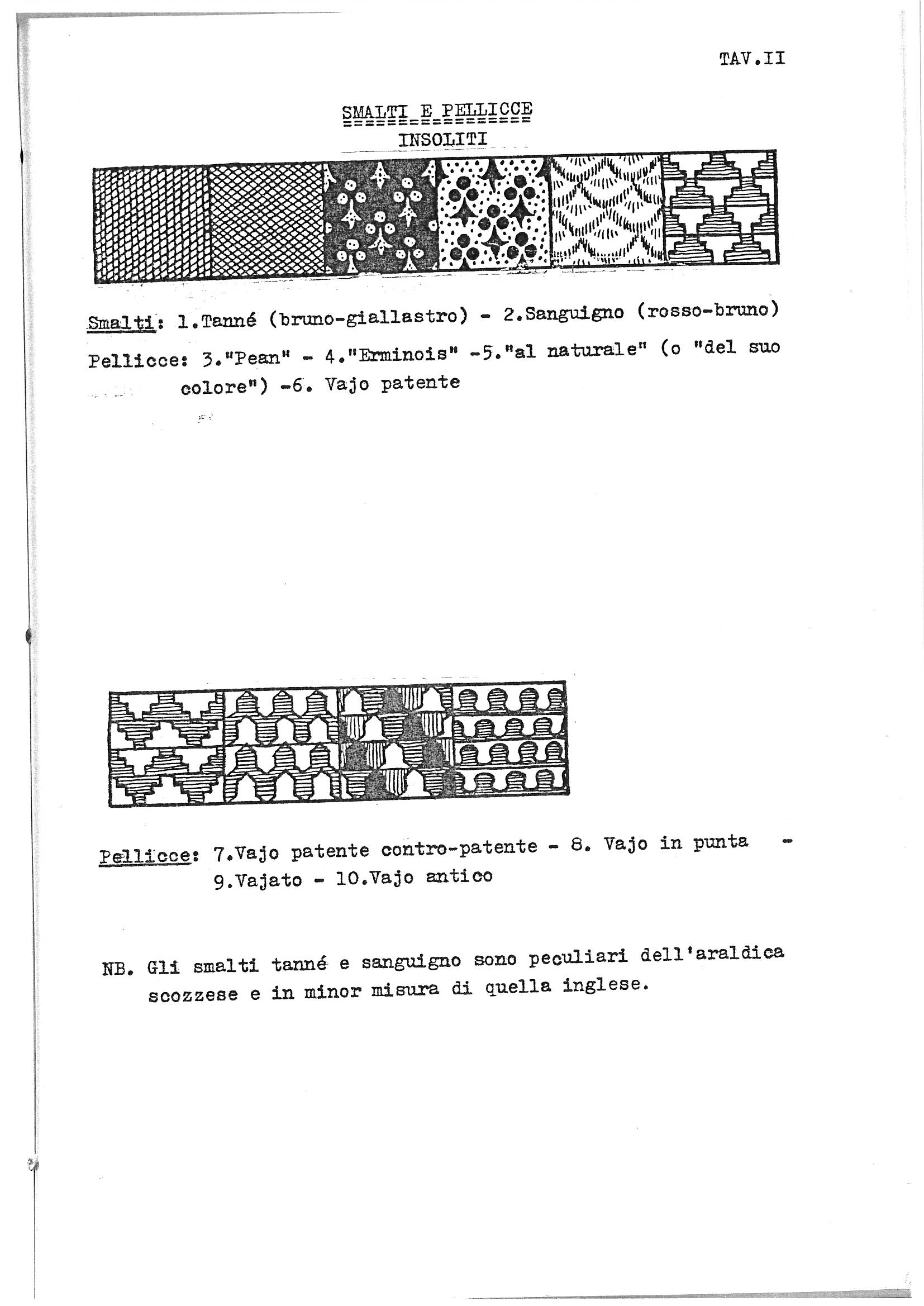
TAV.II
SMALTI E PELLICCE
INSOLITI
Smalti: 1.Tanné (bruno-giallastro) - 2.Sanguigno (rosso-bruno)
Pellicce: 3."Pean" - 4."Erminois" - 5."al naturale" (o "del suo colore") -6. Vajo patente
Pellicce: 7.Vajo patente contro-patente - 8. Vajo in punta - 9.Vajato - 10.Vajo antico
NB. Gli smalti tanné e sanguigno sono peculiari dell'araldica scozzese e in minor misura di quella inglese.
---
TAV.II
UNUSUAL TINCTURES AND FURS
Tinctures: 1. Tenné (brownish-yellow) - 2. Sanguine (reddish-brown)
Furs: 3. "Pean" - 4. "Erminois" - 5. "Proper" (or "of its natural colour") - 6. Potent Vair
Furs: 7. Potent counter-potent - 8. Vair in point - 9. Vairy - 10. Ancient Vair
N.B. The tinctures tenné and sanguine are peculiar to Scottish heraldry and to a lesser extent to English heraldry.
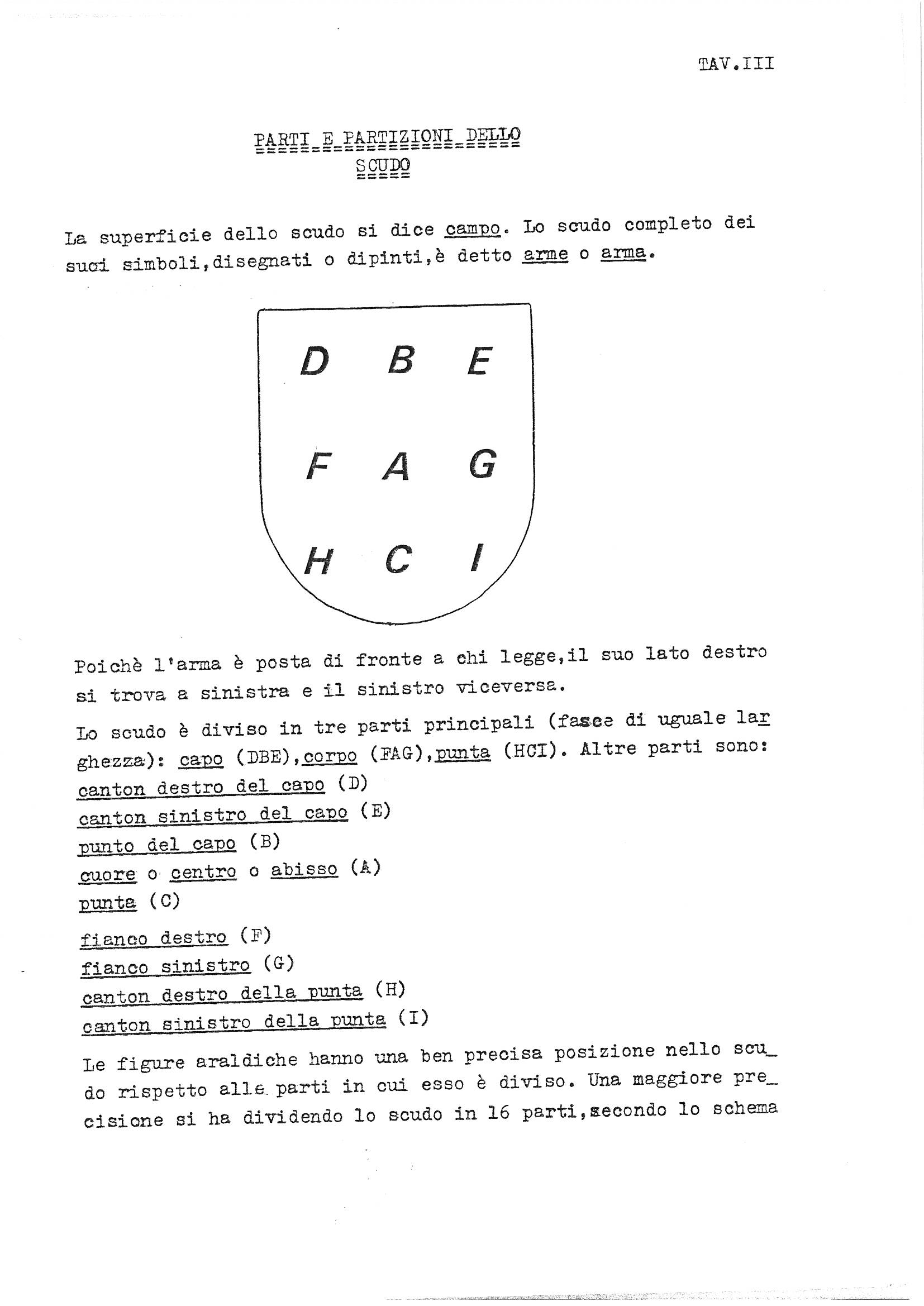
TAV.III
PARTI E PARTIZIONI DELLO SCUDO
La superficie dello scudo si dice campo. Lo scudo completo dei suoi simboli,disegnati o dipinti,è detto arme o arma.
Poichè l'arma è posta di fronte a chi legge,il suo lato destro si trova a sinistra e il sinistro viceversa.
Lo scudo è diviso in tre parti principali (fasce di uguale lar ghezza): capo (DBE),corpo (FAG),punta (HCI). Altre parti sono:
canton destro del capo (D)
canton sinistro del capo (E)
punto del capo (B)
cuore o centro o abisso (A)
punta (C)
fianco destro (F)
fianco sinistro (G)
canton destro della punta (H)
canton sinistro della punta (I)
Le figure araldiche hanno una ben precisa posizione nello scu do rispetto alle parti in cui esso è diviso. Una maggiore pre cisione si ha dividendo lo scudo in 16 parti,secondo lo schema
PLATE III
PARTS AND DIVISIONS OF THE SHIELD
The surface of the shield is called the field. The complete shield with its symbols, drawn or painted, is called arms or coat of arms.
Since the coat of arms is placed before the viewer, its dexter side is found on the left and the sinister side conversely on the right.
The shield is divided into three principal parts (fesses of equal width): chief (DBE), fess (FAG), base (HCI). Other parts are:
dexter canton of the chief (D)
sinister canton of the chief (E)
point of the chief (B)
heart or center or abysm (A)
base (C)
dexter flank (F)
sinister flank (G)
dexter canton of the base (H)
sinister canton of the base (I)
Heraldic figures have a well-defined position on the shield with respect to the parts into which it is divided. Greater precision is obtained by dividing the shield into 16 parts, according to the scheme
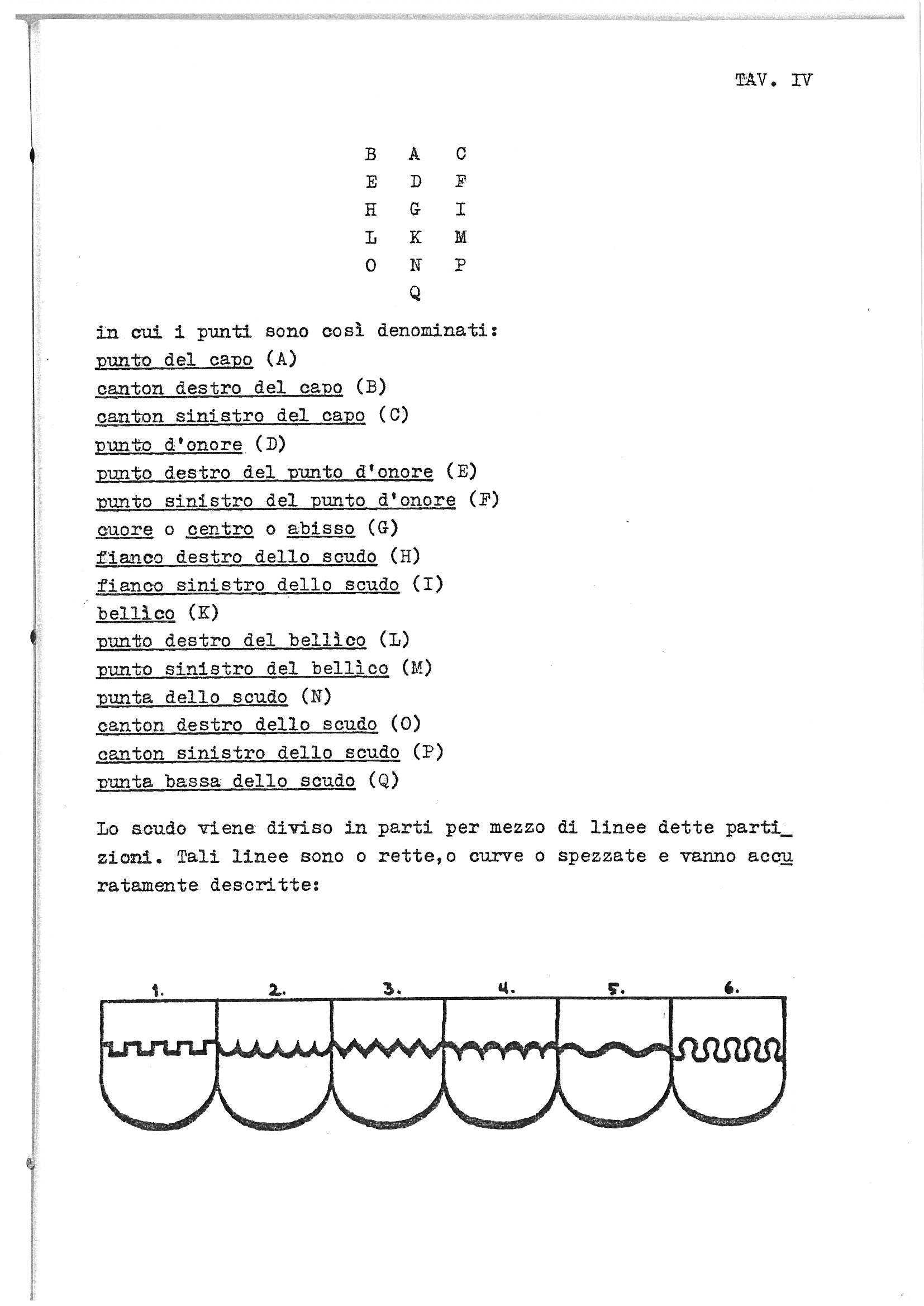
TAV. IV
B A C
E D F
H G I
L K M
O N P
Q
in cui i punti sono così denominati:
punto del capo (A)
canton destro del capo (B)
canton sinistro del capo (C)
punto d'onore (D)
punto destro del punto d'onore (E)
punto sinistro del punto d'onore (F)
cuore o centro o abisso (G)
fianco destro dello scudo (H)
fianco sinistro dello scudo (I)
bellico (K)
punto destro del bellico (L)
punto sinistro del bellico (M)
punta dello scudo (N)
canton destro dello scudo (O)
canton sinistro dello scudo (P)
punta bassa dello scudo (Q)
Lo scudo viene diviso in parti per mezzo di linee dette partizioni. Tali linee sono o rette,o curve o spezzate e vanno accuratamente descritte:
TAV. IV
B A C
E D F
H G I
L K M
O N P
Q
in which the points are thus denominated:
point of the chief (A)
dexter canton of the chief (B)
sinister canton of the chief (C)
point of honour (D)
dexter point of the point of honour (E)
sinister point of the point of honour (F)
heart or centre or abyss (G)
dexter flank of the shield (H)
sinister flank of the shield (I)
nombril point (K)
dexter nombril point (L)
sinister nombril point (M)
base point (N)
dexter base point (O)
sinister base point (P)
base (Q)
The shield is divided into parts by means of lines called partitions. Such lines are either straight, curved, or broken, and must be accurately described:
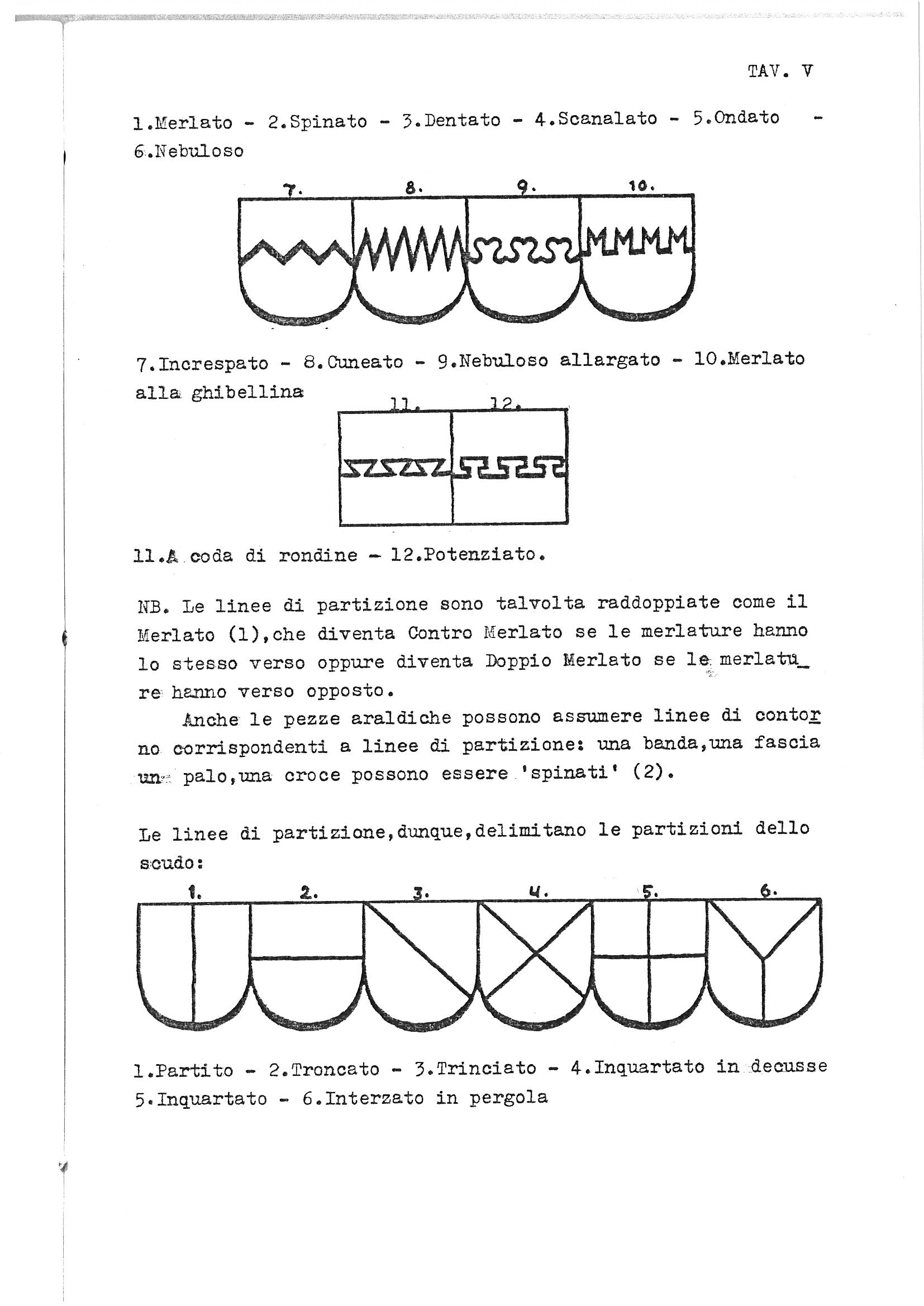
TAV. V
1.Merlato - 2.Spinato - 3.Dentato - 4.Scanalato - 5.Ondato -
6.Nebuloso
7.Increspato - 8.Cuneato - 9.Nebuloso allargato - 10.Merlato
alla ghibellina
11.A coda di rondine - 12.Potenziato.
NB. Le linee di partizione sono talvolta raddoppiate come il
Merlato (1),che diventa Contro Merlato se le merlature hanno
lo stesso verso oppure diventa Doppio Merlato se le merlatu_
re hanno verso opposto.
Anche le pezze araldiche possono assumere linee di contorno corrispondenti a linee di partizione: una banda,una fascia un- palo,una croce possono essere 'spinati' (2).
Le linee di partizione,dunque,delimitano le partizioni dello
scudo:
1.Partito - 2.Troncato - 3.Trinciato - 4.Inquartato in decusse
5.Inquartato - 6.Interzato in pergola
---
TAV. V
1. Embattled - 2. Engrailed - 3. Indented - 4. Invected - 5. Wavy -
6. Nebuly
7. Dancetty - 8. Cuneato † - 9. Nebuly, enlarged ‡ - 10. Embattled à la
Ghibelline
11. Dovetailed - 12. Potenty.
NB. The partition lines are sometimes doubled, as in the Embattled
(1), which becomes Counter-embattled if the embattlements face the
same direction, or becomes Double Embattled if the embattlements
face opposite directions.
Likewise, the heraldic charges may assume outline lines corresponding
to partition lines: a bend, a fess, a pale, a cross may be 'engrailed'
(2).
The partition lines, therefore, delimit the divisions of the
shield:
1. Party per pale - 2. Party per fess - 3. Party per bend - 4. Quarterly
in saltire - 5. Quarterly - 6. Tierced in paly
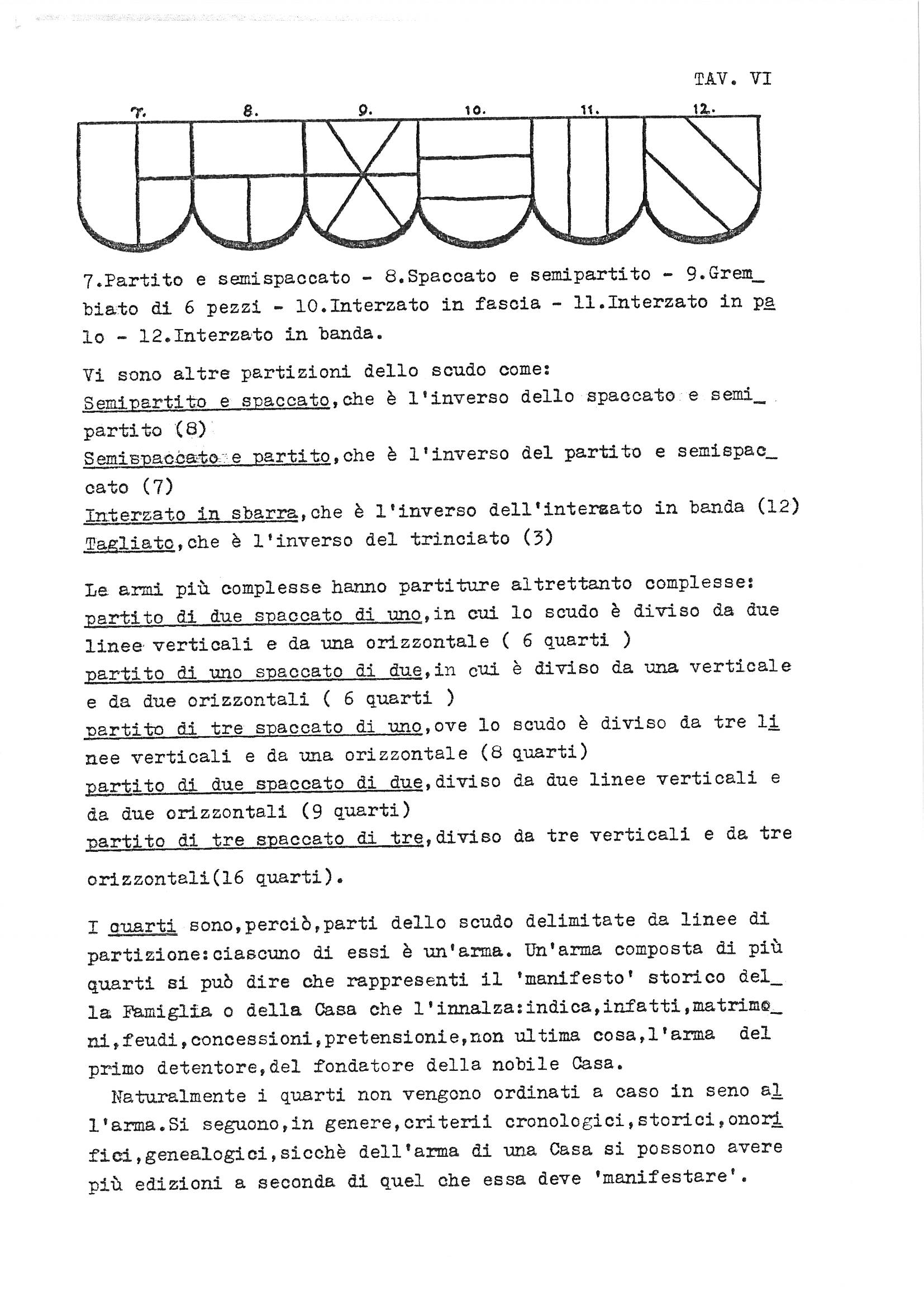
7.Partito e semispacato - 8.Spacato e semipartito - 9.Grem biato di 6 pezzi - 10.Interzato in fascia - 11.Interzato in pa lo - 12.Interzato in banda.
Vi sono altre partizioni dello scudo come:
Semipartito e spacato, che è l'inverso dello spacato e semi_ partito (8)
Semispacato e partito, che è l'inverso del partito e semispac_ cato (7)
Interzato in sbarra, che è l'inverso dell'interzato in banda (12)
Tagliato, che è l'inverso del trinciato (3)
Le armi più complesse hanno partiture altrettanto complesse:
partito di due spacato di uno, in cui lo scudo è diviso da due linee verticali e da una orizzontale ( 6 quarti )
partito di uno spacato di due, in cui è diviso da una verticale e da due orizzontali ( 6 quarti )
partito di tre spacato di uno, ove lo scudo è diviso da tre li nee verticali e da una orizzontale (8 quarti)
partito di due spacato di due, diviso da due linee verticali e da due orizzontali (9 quarti)
partito di tre spacato di tre, diviso da tre verticali e da tre orizzontali(16 quarti).
I quarti sono, però, parti dello scudo delimitate da linee di partizione: ciascuno di essi è un'arma. Un'arma composta di più quarti si può dire che rappresenti il 'manifesto' storico del_ la Famiglia o della Casa che l'innalza; indica, infatti, matrimo_ ni, feudi, concessioni, pretensioni, non ultima cosa, l'arma del primo detentore, del fondatore della nobile Casa.
Naturalmente i quarti non vengono ordinati a caso in seno al l'arma. Si seguono, in genere, criteri cronologici, storici, onori fici, genealogici, sicché dell'arma di una Casa si possono avere più edizioni a seconda di quel che essa deve 'manifestare'.
7. Party per pale and party per fess - 8. Party per fess and party per pale - 9. Chequy of 6 pieces - 10. Tierced in fess - 11. Tierced in pale - 12. Tierced in bend.
There are other divisions of the shield, such as:
Party per pale and party per fess, which is the reverse of party per fess and party per pale (8)
Party per fess and party per pale, which is the reverse of party per pale and party per fess (7)
Tierced in bend sinister, which is the reverse of tierced in bend (12)
Party per bend, which is the reverse of party per bend sinister (3)
The most complex arms have equally complex divisions:
party per pale of two, party per fess of one, in which the shield is divided by two vertical lines and one horizontal line (6 quarters)
party per pale of one, party per fess of two, in which it is divided by one vertical line and two horizontal lines (6 quarters)
party per pale of three, party per fess of one, wherein the shield is divided by three vertical lines and one horizontal line (8 quarters)
party per pale of two, party per fess of two, divided by two vertical lines and two horizontal lines (9 quarters)
party per pale of three, party per fess of three, divided by three vertical and three horizontal lines (16 quarters).
The quarters are, however, divisions of the shield delimited by lines of partition: each of them constitutes an arm. A coat of arms composed of multiple quarters may be said to represent the historical 'manifesto' of the Family or House that bears it; it indicates, indeed, marriages, fiefs, grants, claims, and not least, the arms of the first holder, the founder of the noble House.
Naturally the quarters are not arranged haphazardly within the arms. One generally follows chronological, historical, honorific, and genealogical criteria, so that the arms of a House may have multiple versions depending on what it must 'display'.
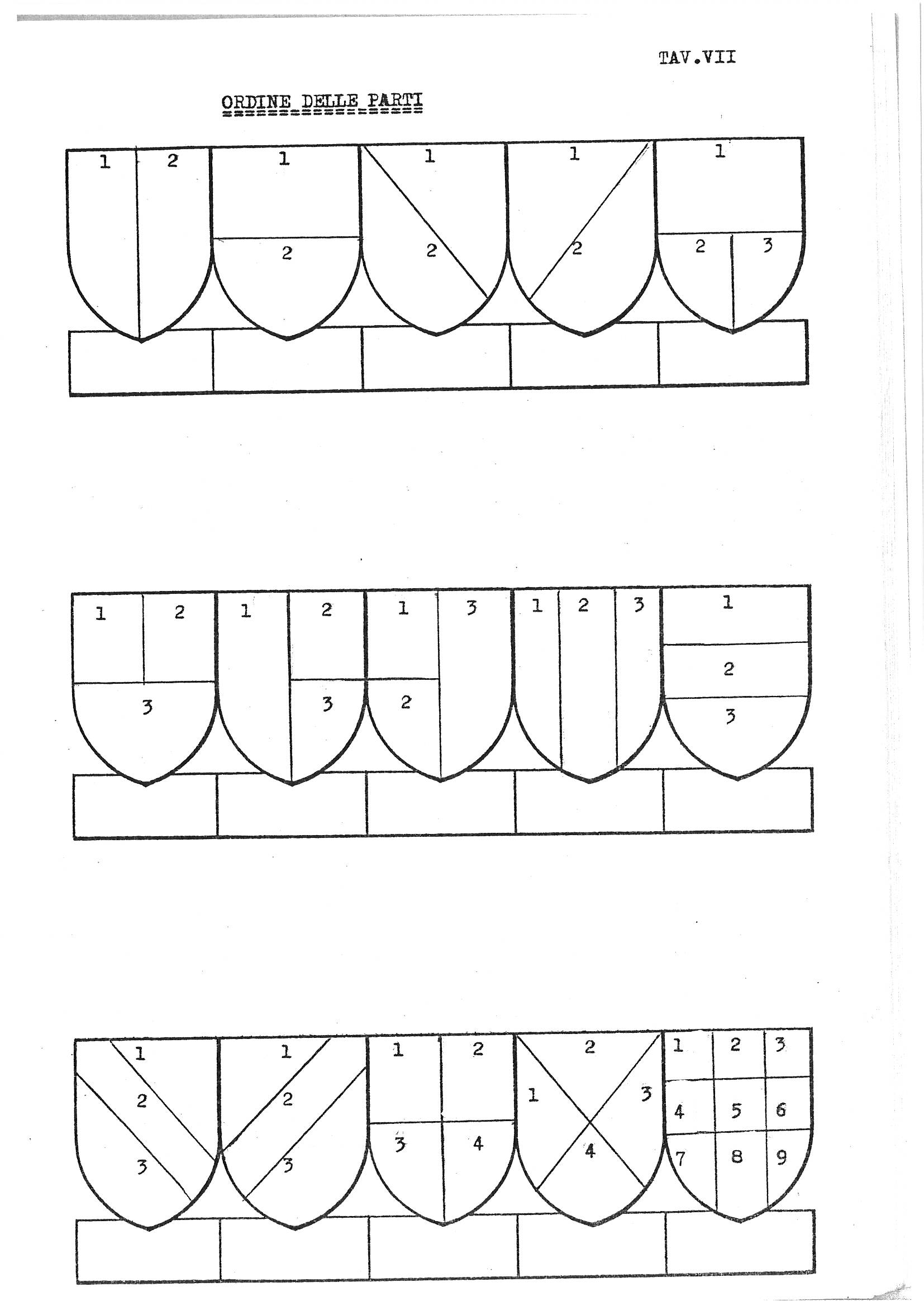
TAV.VII
ORDINE DELLE PARTI
PLATE VII
ORDER OF THE PARTS
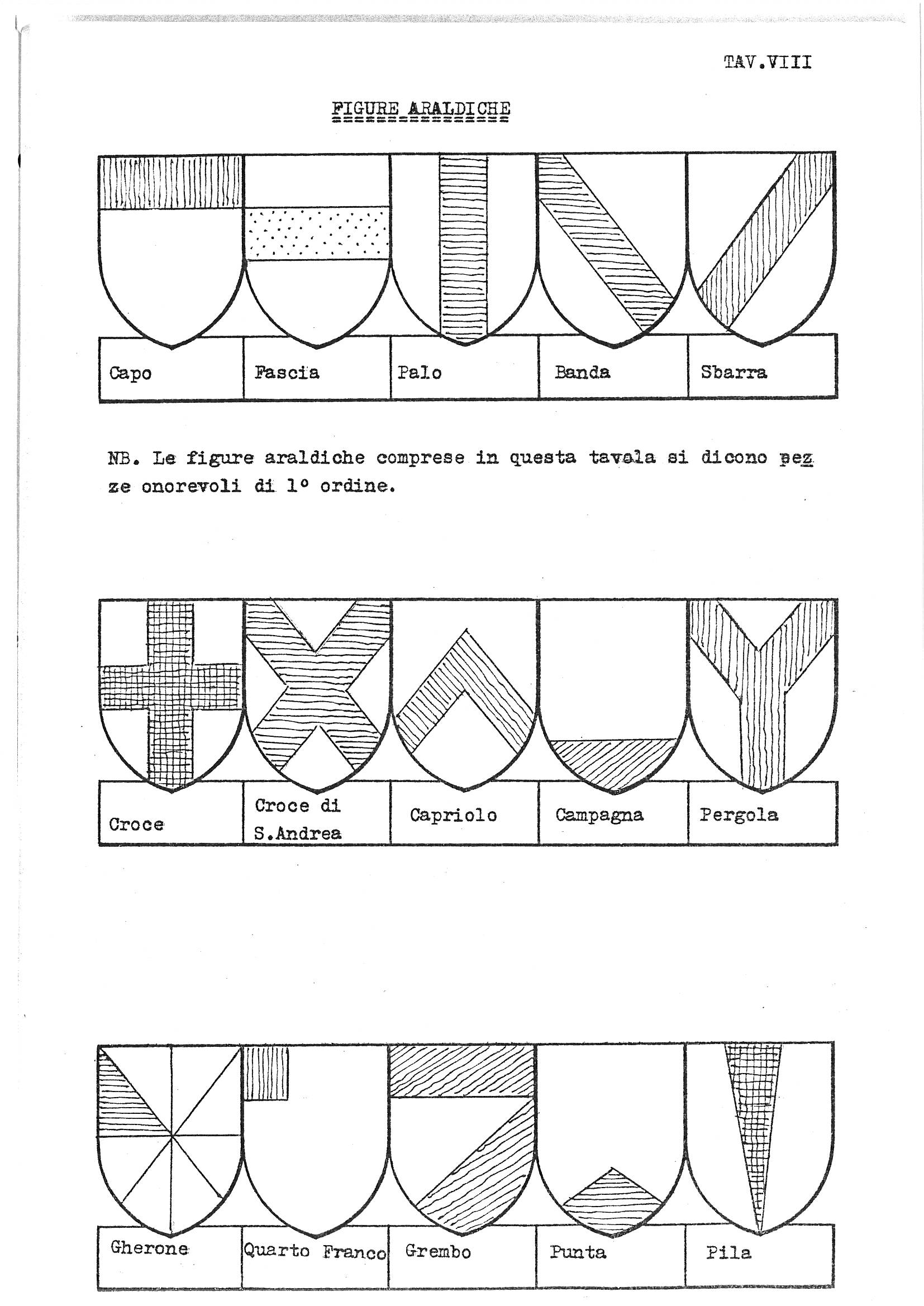
TAV.VIII
FIGURE ARALDICHE
Capo
Fascia
Palo
Banda
Sbarra
NB. Le figure araldiche comprese in questa tavola si dicono pezze onorevoli di 1° ordine.
Croce
Croce di S.Andrea
Capriolo
Campagna
Pergola
Gherone
Quarto Franco
Grembo
Punta
Pila
---
PLATE VIII
HERALDIC ORDINARIES
Chief
Fess
Pale
Bend (Dexter)
Bend Sinister
NB. The heraldic ordinaries comprised in this plate are called honorable charges of the first order.
Cross
Saltire
Chevron
Paly
Trellis
Flank
Frankquarter
Inescutcheon
Point
Pillar
---
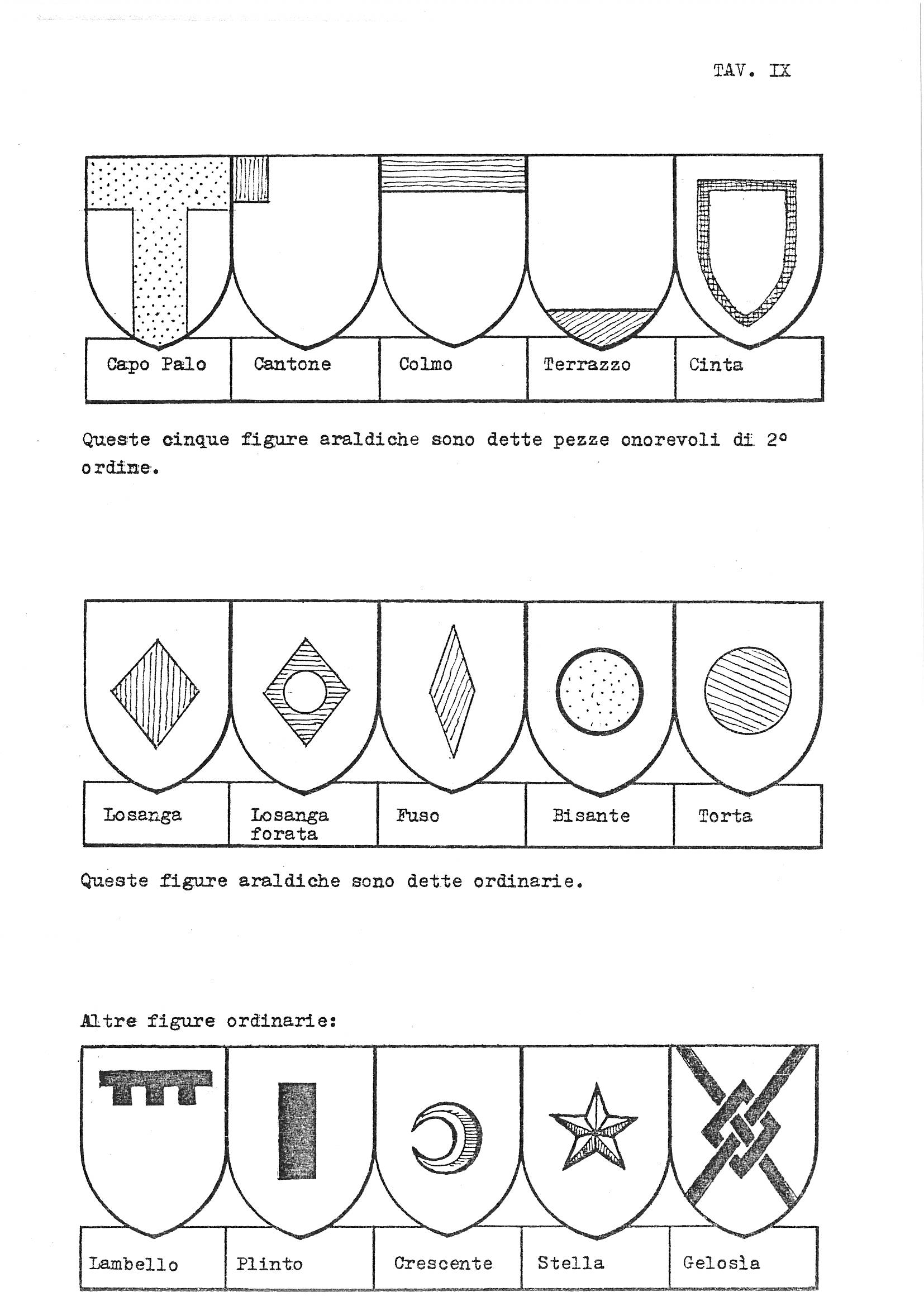
TAV. IX
Capo Palo
Cantone
Colmo
Terrazzo
Cinta
Queste cinque figure araldiche sono dette pezze onorevoli di 2°
ordine.
Losanga
Losanga forata
Fuso
Bisante
Torta
Queste figure araldiche sono dette ordinarie.
Altre figure ordinarie:
Lambello
Plinto
Crescente
Stella
Gelosia
---
TAV. IX
Chief Pale
Canton
Chevron
Terrace
Orle
These five heraldic figures are called charges of the 2nd order.
Lozenge
Voided Lozenge
Fusil
Bezant
Roundel
These heraldic figures are called ordinaries.
Other ordinaries:
Label
Plinth
Crescent
Star
Fret
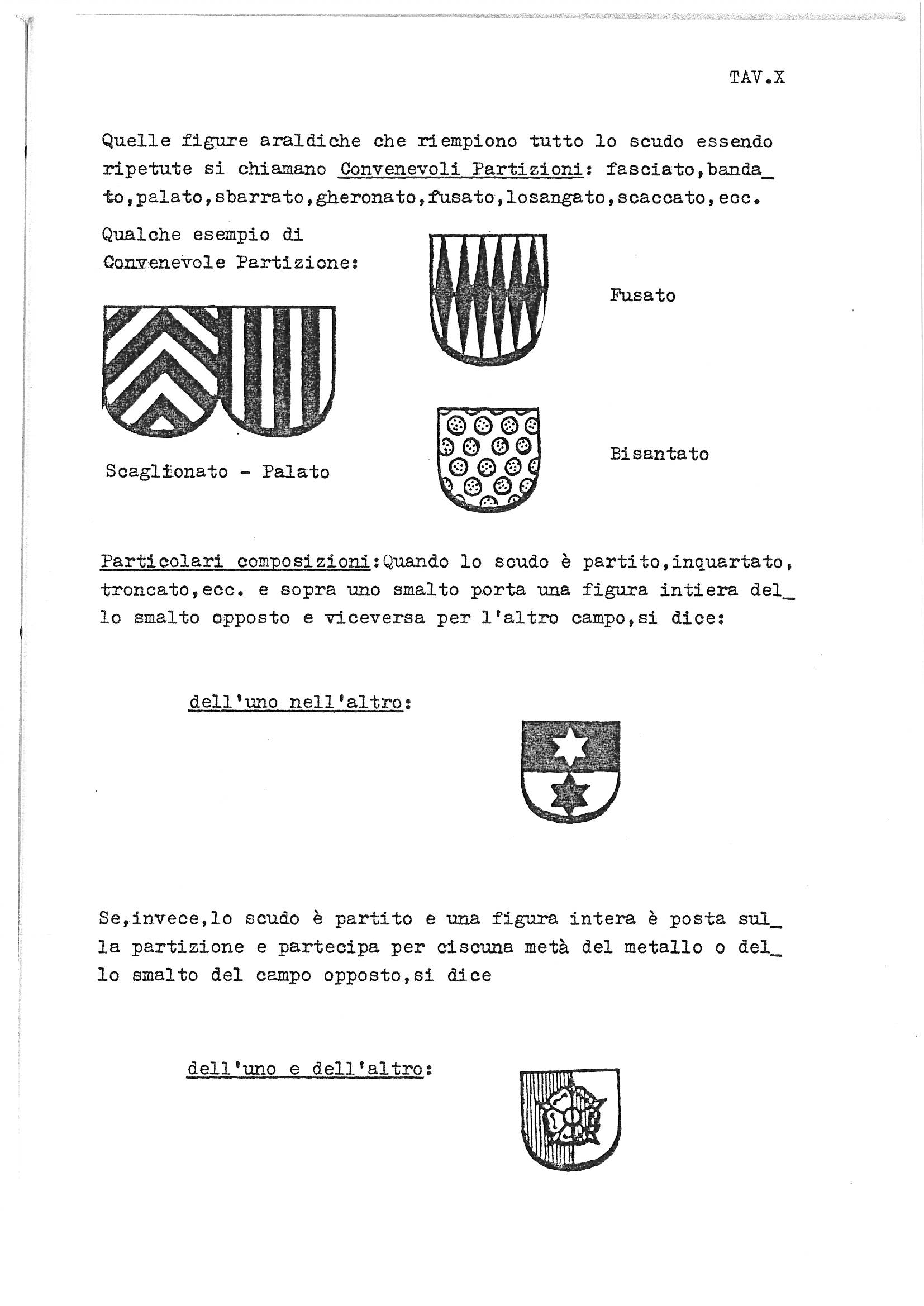
TAV. X
Quelle figure araldiche che riempiono tutto lo scudo essendo ripetute si chiamano Convenevoli Partizioni: fasciato, bandato, palato, sbarrato, gheronato, fusato, losangato, scaccato, ecc.
Qualche esempio di Convenevoli Partizione:
Scaglionato – Palato
Fusato
Bisantato
Particolari composizioni: Quando lo scudo è partito, inquartato, troncato, ecc. e sopra uno smalto porta una figura intiera dello smalto opposto e viceversa per l'altro campo, si dice:
dell'uno nell'altro:
Se, invece, lo scudo è partito e una figura intera è posta sulla partizione e partecipa per ciscuna metà del metallo o dello smalto del campo opposto, si dice
dell'uno e dell'altro:
---
PLATE X
Those heraldic figures that fill the entire shield, being repeated, are called Suitable Partitions: fessywise, bendwise, paleise, bendy sinister, gyronny, fusilly, lozengy, checky, etc.
Some examples of Suitable Partition:
Chevronny – Paleise
Fusilly
Billetty
Particular compositions: When the shield is party per pale, quarterly, party per fess, etc. and over one tincture it bears an entire figure of the opposite tincture and vice versa for the other field, it is said:
of the one in the other:
If, instead, the shield is party per pale and an entire figure is placed upon the partition and participates for each half of the metal or tincture of the opposite field, it is said
of the one and the other:
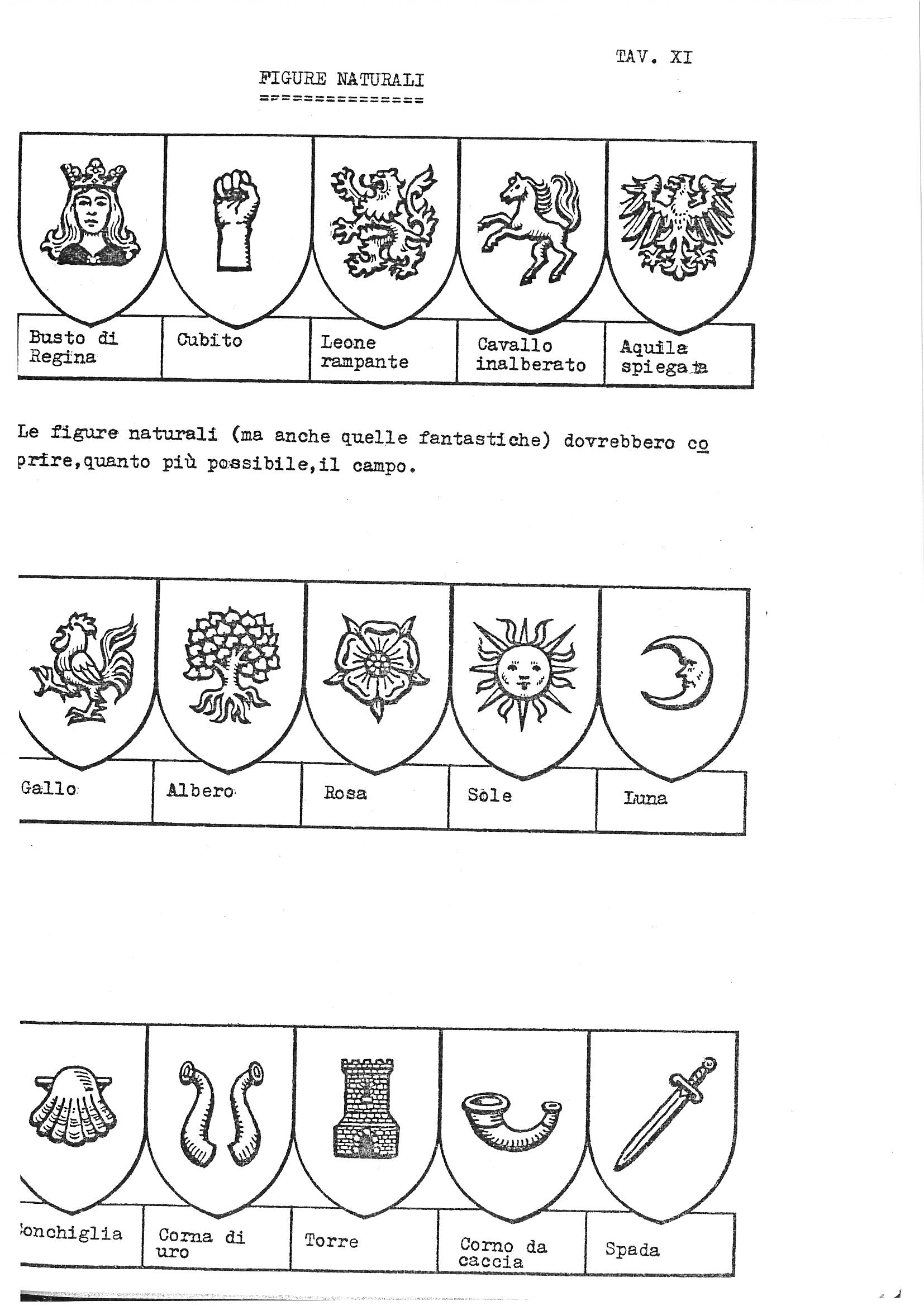
TAV. XI
FIGURE NATURALI
==============
Busto di Regina
Cubito
Leone rampante
Cavallo inalberato
Aquila spiegata
Le figure naturali (ma anche quelle fantastiche) dovrebbero coprire, quanto più possibile, il campo.
Gallo
Albero
Rosa
Sole
Luna
Conchiglia
Corna di uro
Torre
Corno da caccia
Spada
TAV. XI
NATURAL FIGURES
===============
Bust of a Queen
Arm
Lion rampant
Horse reared
Eagle displayed
Natural figures (but also fantastic ones) should cover the field as much as possible.
Cock
Tree
Rose
Sun
Moon
Shell
Aurochs' horns
Tower
Hunting horn
Sword
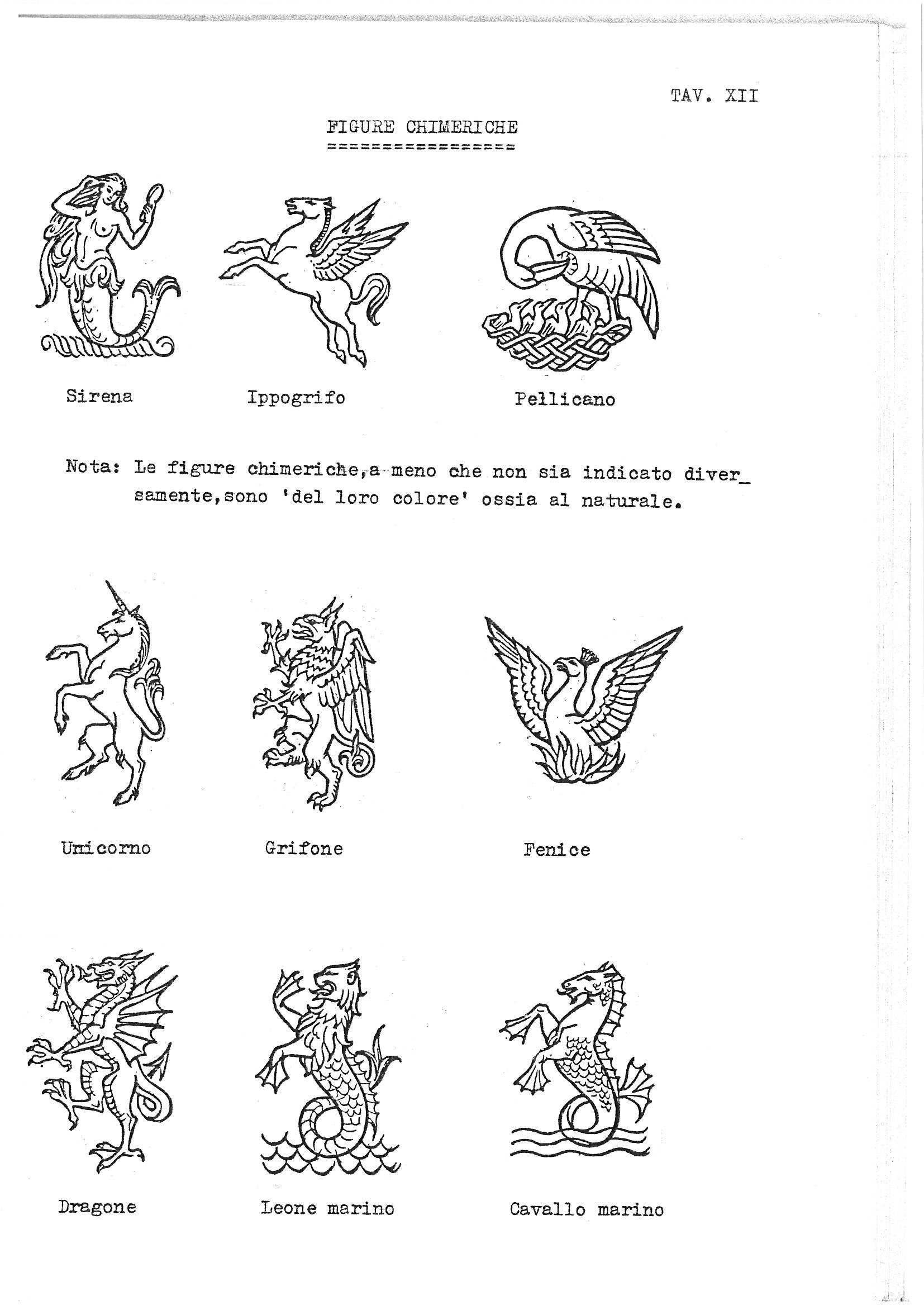
TAV. XII
FIGURE CHIMERICHE
================
Sirena Ippogrifo Pellicano
Nota: Le figure chimeriche, a meno che non sia indicato diver_
samente, sono 'del loro colore' ossia al naturale.
Unicorno Grifone Fenice
Dragone Leone marino Cavallo marino
TABLE XII
CHIMERICAL FIGURES
================
Mermaid Hippogriff Pelican (in her piety)
Note: Chimerical figures, unless otherwise indicated, are 'of their natural colour' that is to say depicted naturally.
Unicorn Griffin Phoenix
Dragon Sea-Lion Sea-Horse
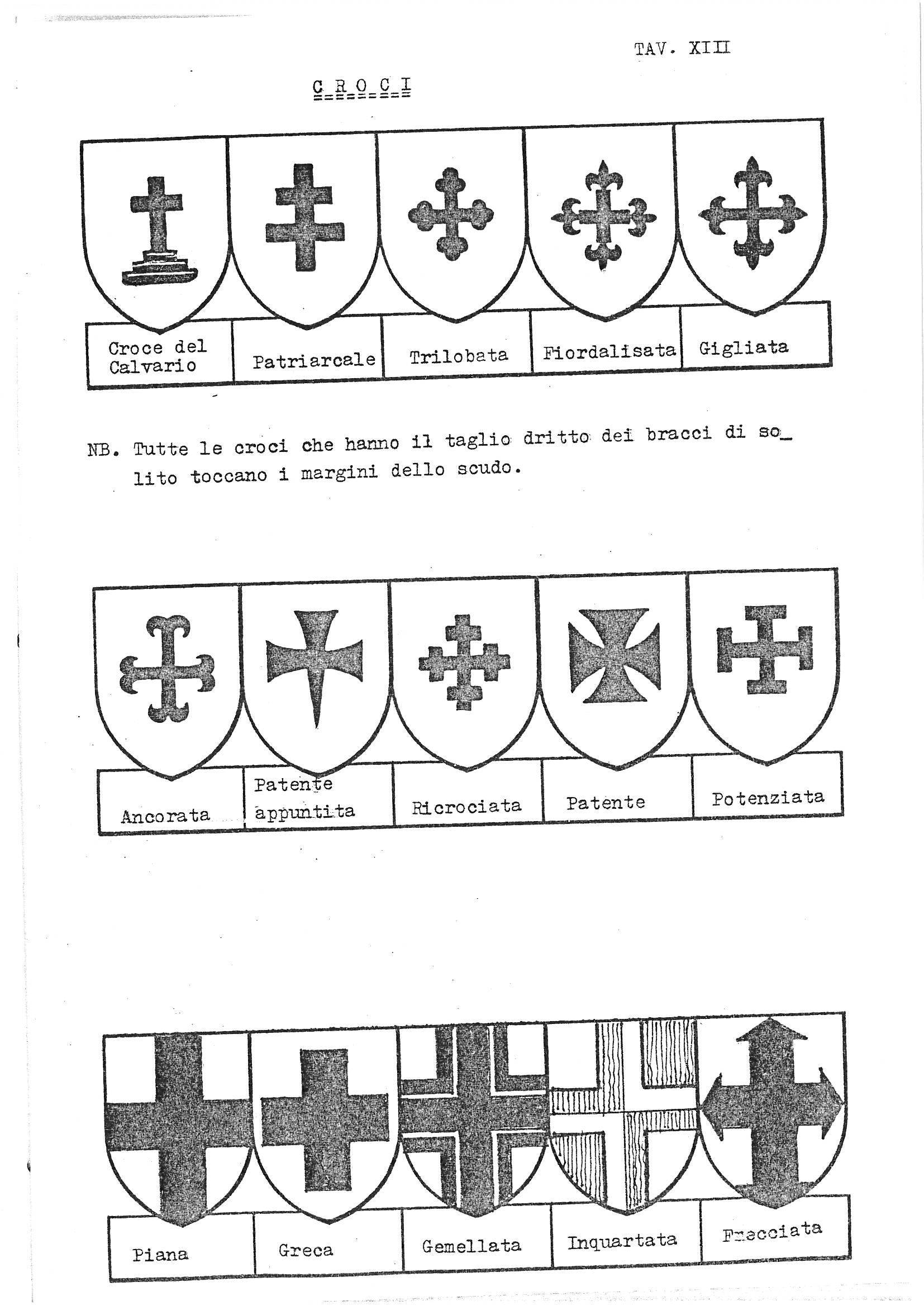
TAV. XIII
CROCI
Croce del Calvario | Patriarcale | Trilobata | Fiordalisata | Gigliata
NB. Tutte le croci che hanno il taglio dritto dei bracci di solito toccano i margini dello scudo.
Ancorata | Patente appuntita | Ricrociata | Patente | Potenziata
Piana | Greca | Gemellata | Inquartata | Frecciata
---
TAV. XIII
CROSSES
Cross of Calvary | Patriarchal | Trilobate | Flory | Fleur-de-lis
NB. All crosses which have straight-cut arms usually touch the edges of the shield.
Anchorée | Pointed patonce | Cross crosslet | Patonce | Potent
Plain | Greek | Gemelled | Quarterly | Cross fléchée
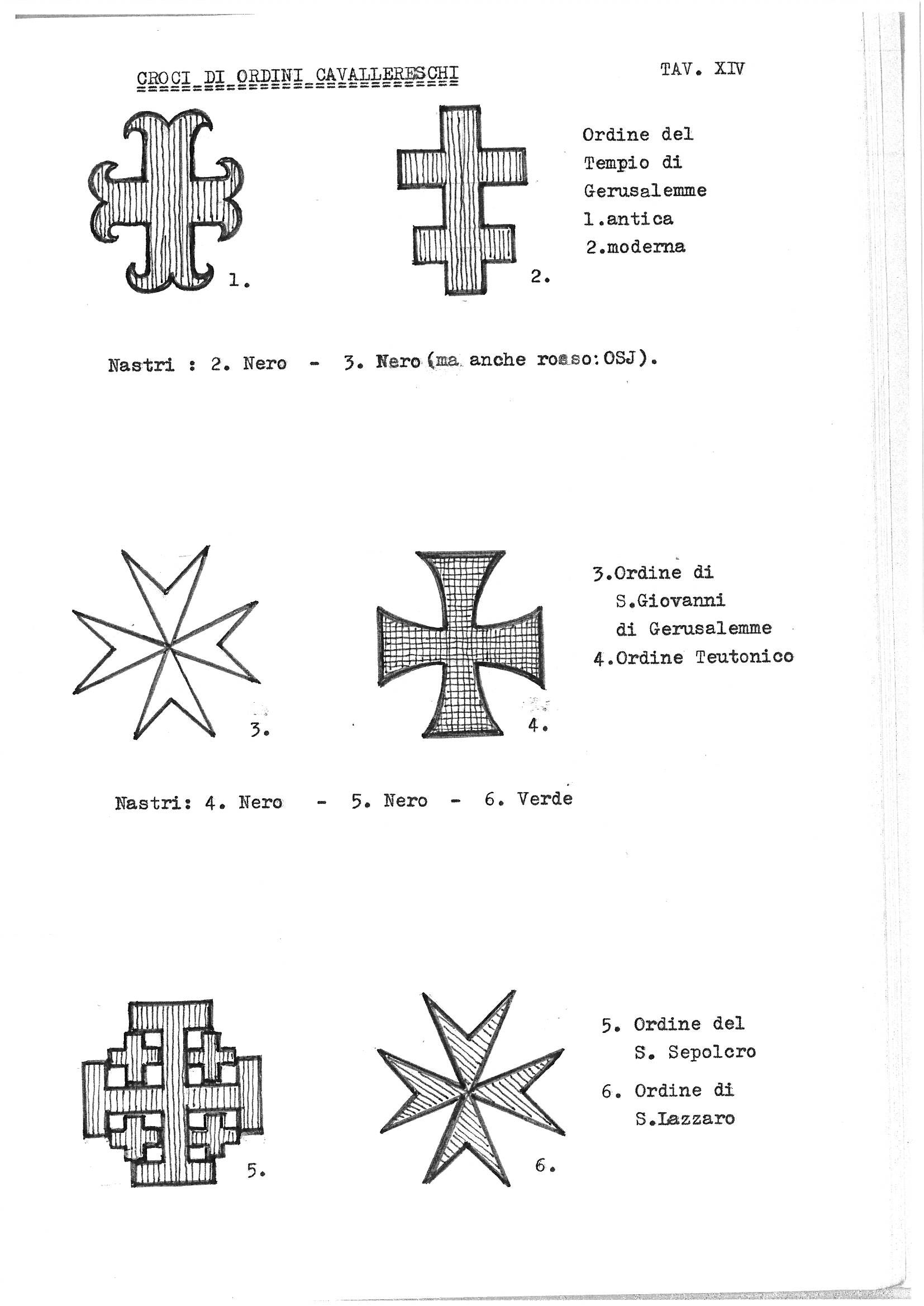
CROCI DI ORDINI CAVALLERESCHI TAV. XIV
1. 2.
Ordine del
Tempio di
Gerusalemme
1.antica
2.moderna
Nastri: 2. Nero - 3. Nero (ma anche rosso: OSJ).
3.Ordine di
3. 4. S.Giovanni
di Gerusalemme
4.Ordine Teutonico
Nastri: 4. Nero - 5. Nero - 6. Verde
5.Ordine del
5. 6. S. Sepolcro
6.Ordine di
S.Lazzaro
---
CROSSES OF CHIVALRIC ORDERS TAB. XIV
1. 2.
Order of the
Temple of
Jerusalem
1. ancient
2. modern
Ribbons: 2. Black - 3. Black (but also red: OSJ).
3. Order of
3. 4. St. John
of Jerusalem
4. Teutonic Order
Ribbons: 4. Black - 5. Black - 6. Green
5. Order of the
5. 6. Holy Sepulchre
6. Order of
St. Lazarus
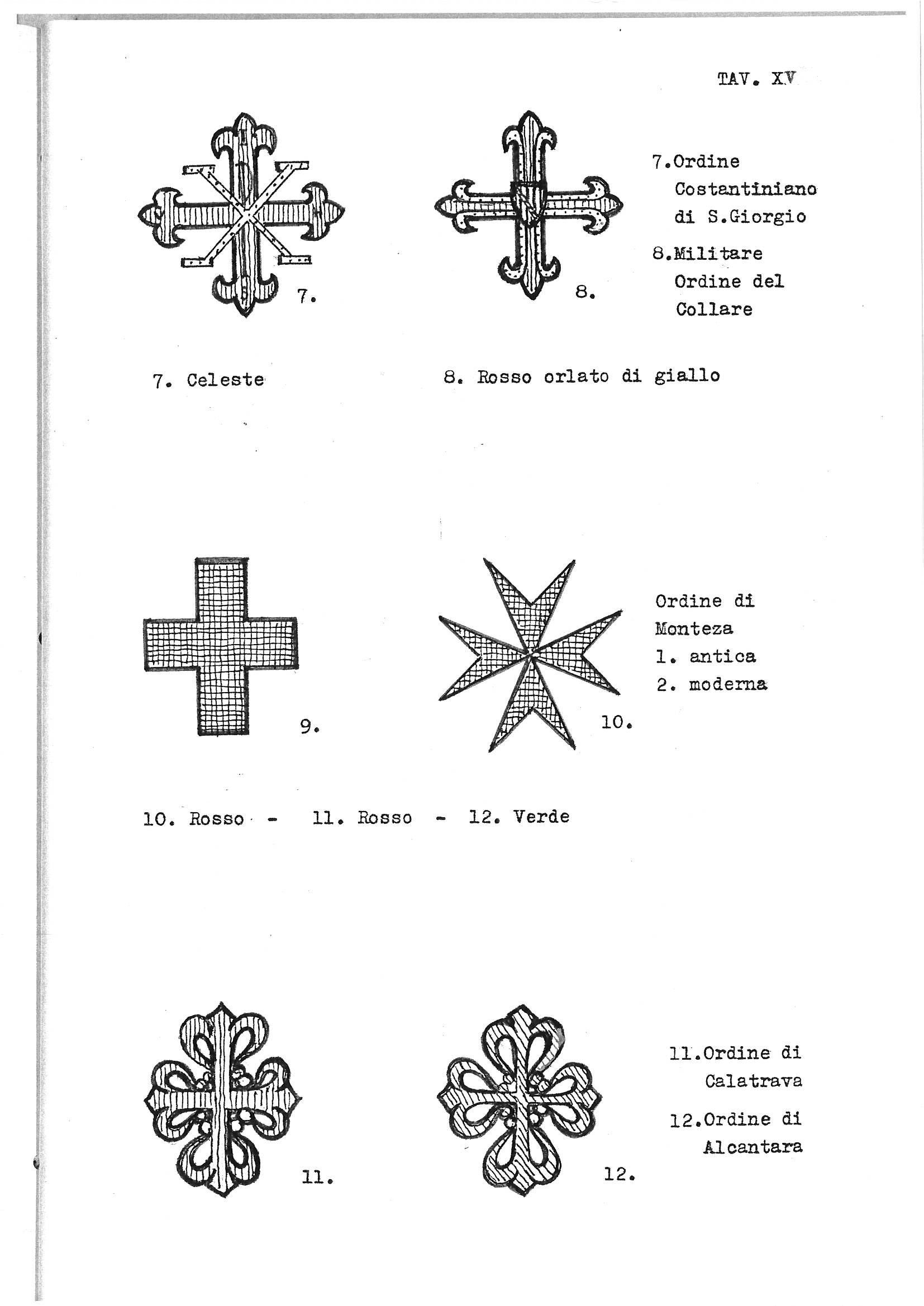
TAV. XV
7.
8.
7.Ordine
Costantiniano
di S.Giorgio
8.Militare
Ordine del
Collare
7. Celeste 8. Rosso orlato di giallo
9.
10.
Ordine di
Montesa
1. antica
2. moderna
9. Rosso – 10. Rosso – 11. Rosso – 12. Verde
11.
12.
11.Ordine di
Calatrava
12.Ordine di
Alcantara
---
TAV. XV
7.
8.
7. Constantinian
Order
of St. George
8. Military
Order of
the Collar
7. Celeste 8. Gules semé of Or
9.
10.
Order of
Montesa
1. ancient
2. modern
9. Gules – 10. Gules – 11. Gules – 12. Vert
11.
12.
11. Order of
Calatrava
12. Order of
Alcántara
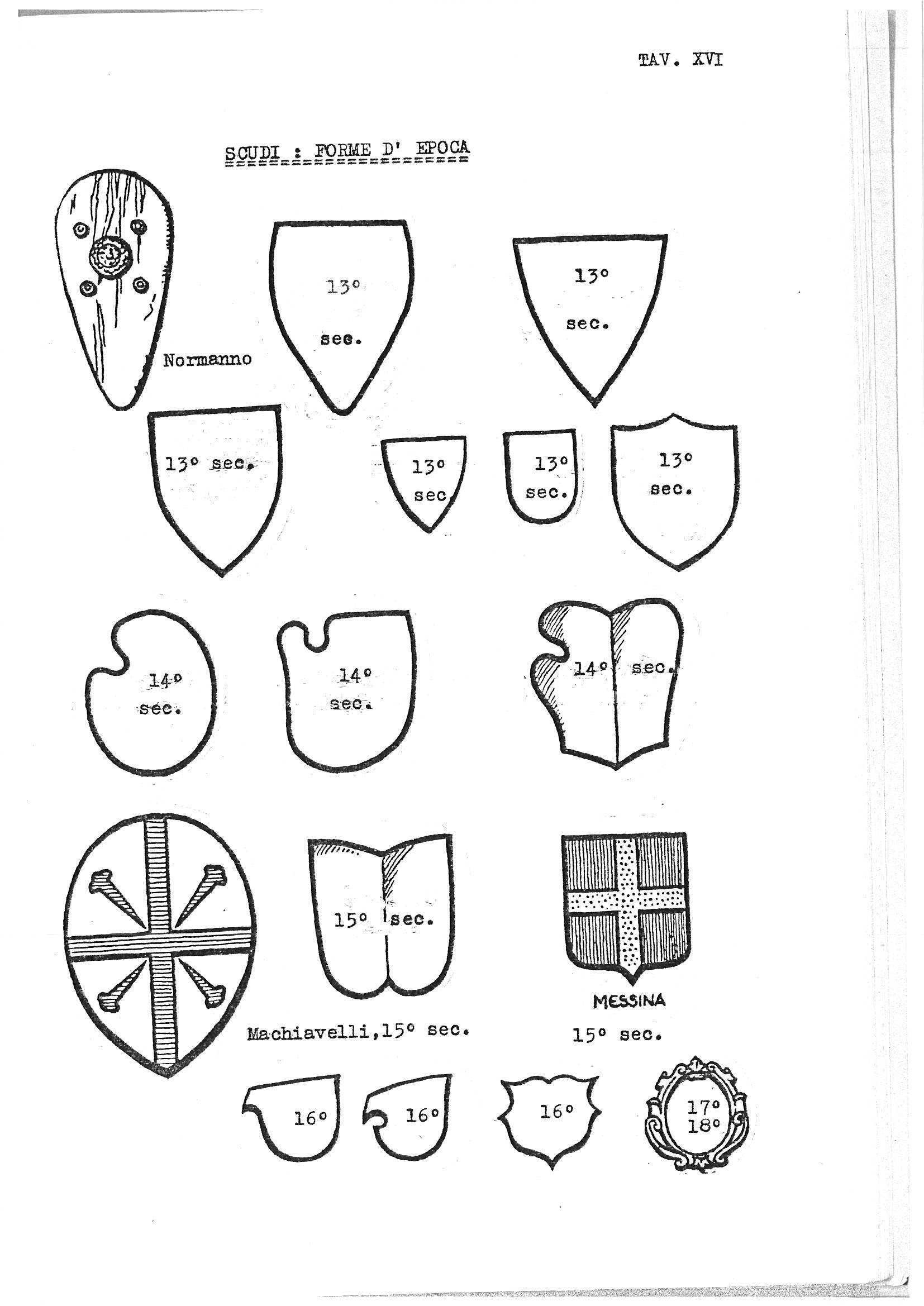
TAV. XVI
SCUDI : FORME D' EPOCA
Normanno
13°
sec.
13°
sec.
13° sec.
13°
sec.
13°
sec.
13°
sec.
14°
sec.
14°
sec.
14° sec.
Machiavelli, 15° sec.
15° sec.
MESSINA
15° sec.
16°
16°
16°
17°
18°
---
PLATE XVI
SHIELDS: PERIOD FORMS
Norman
13th
cent.
13th
cent.
13th cent.
13th
cent.
13th
cent.
13th
cent.
14th
cent.
14th
cent.
14th cent.
Machiavelli, 15th cent.
15th cent.
MESSINA
15th cent.
16th
16th
16th
17th
18th
---
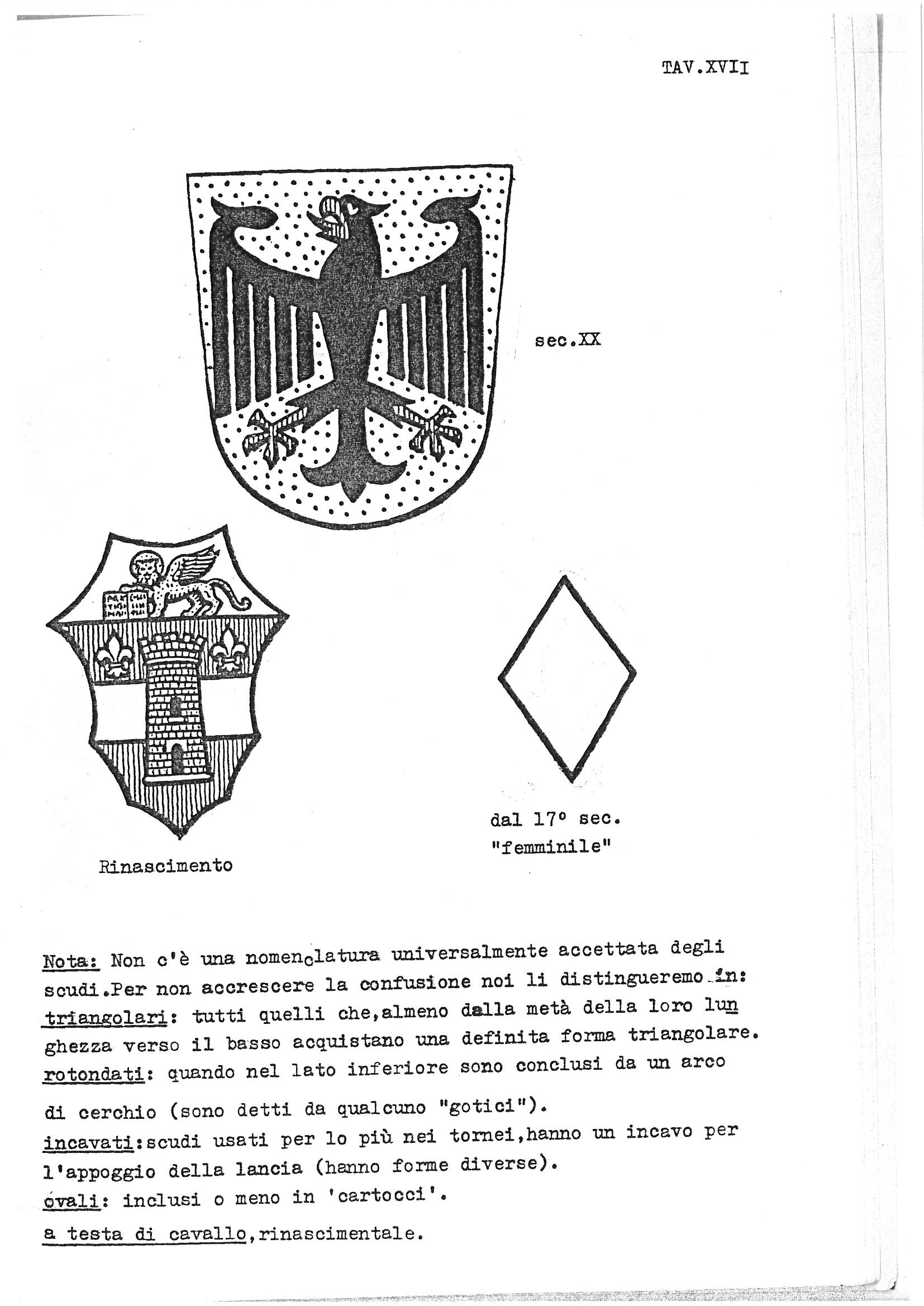
TAV.XVII
sec.XX
Rinascimento
dal 17° sec.
"femminile"
Nota: Non c'è una nomenclatura universalmente accettata degli scudi.Per non accrescere la confusione noi li distingueremo in:
triangolari: tutti quelli che,almeno dalla metà della loro lunghezza verso il basso acquistano una definita forma triangolare.
rotondati: quando nel lato inferiore sono conclusi da un arco di cerchio (sono detti da qualcuno "gotici").
incavati:scudi usati per lo più nei tornei,hanno un incavo per l'appoggio della lancia (hanno forme diverse).
ovali: inclusi o meno in 'cartocci'.
a testa di cavallo,rinascimentale.
TAV.XVII
20th century
Renaissance
from 17th century
"feminine"
Note: There is no universally accepted nomenclature for shields. To avoid adding to the confusion, we shall distinguish them as follows:
triangular: all those that, at least from the midpoint of their length downwards, acquire a definite triangular shape.
rounded: when the lower side is concluded by a circular arc (some call them "gothic").
bouché: shields used mostly in tournaments, they have a notch (bouché) for the support of the lance (they have various forms).
oval: enclosed or not in cartouches.
horsehead, Renaissance.
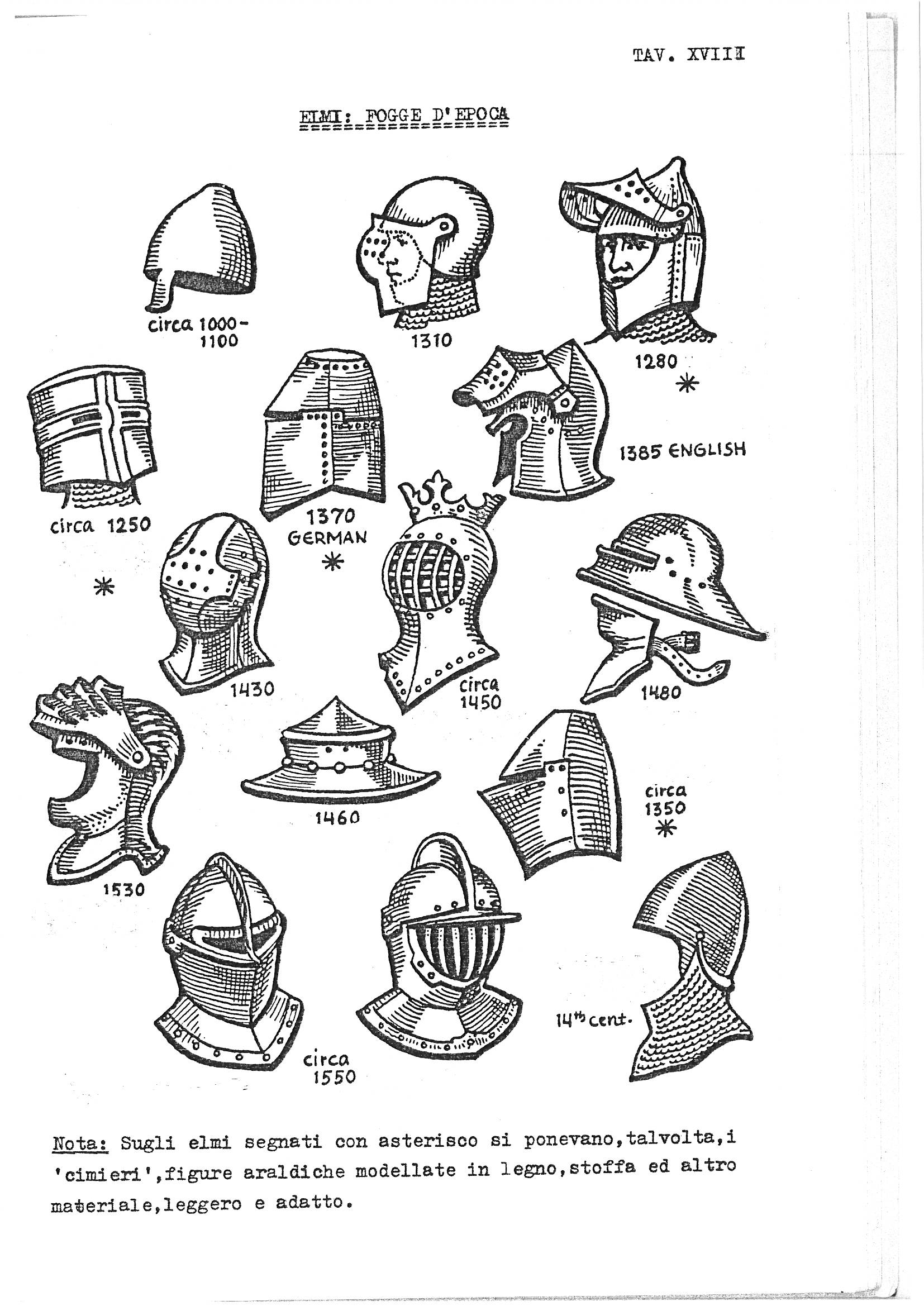
ELMI: FOGGE D'EPOCA
circa 1000-
1100
1310
1280
*
circa 1250
1370
GERMAN
*
1385 ENGLISH
1430
circa
1450
1480
1530
1460
circa
1350
*
14th cent.
Note: Sugli elmi segnati con asterisco si ponevano, talvolta, i
'cimieri', figure araldiche modellate in legno, stoffa ed altro
materiale, leggero e adatto.
---
HELMS: PERIOD STYLES
circa 1000-
1100
1310
1280
*
circa 1250
1370
GERMAN
*
1385 ENGLISH
1430
circa
1450
1480
1530
1460
circa
1350
*
14th cent.
Note: Upon the helms marked with an asterisk were sometimes placed
'crests', heraldic figures modelled in wood, fabric and other light
and suitable materials.
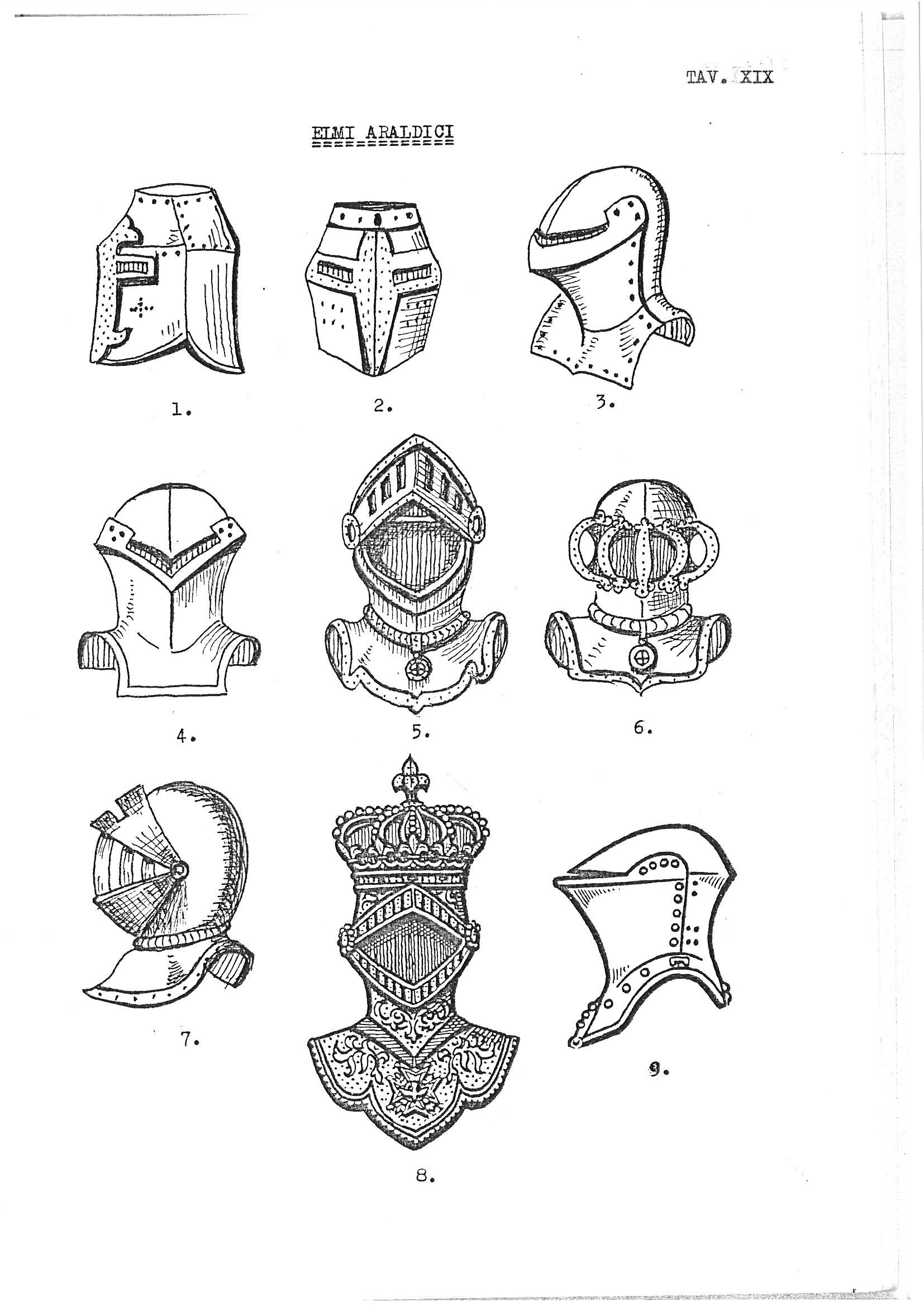
ELMI ARALDICI
HERALDIC HELMS
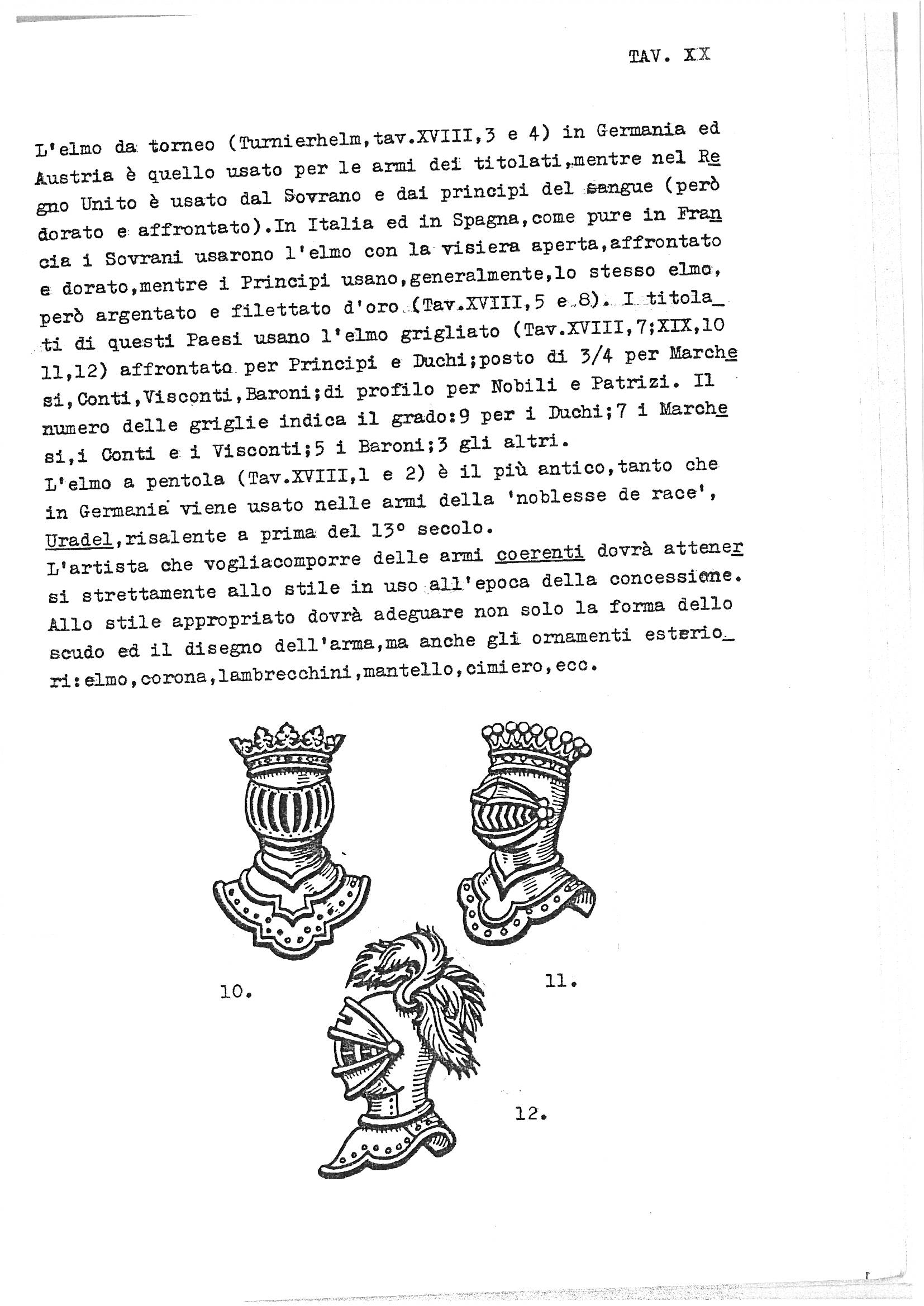
L'elmo da torneo (Turnierhelm,tav.XVIII,3 e 4) in Germania ed Austria è quello usato per le armi dei titoleti,mentre nel Re gno Unito è usato dal Sovrano e dai principali del sangue (però dorato e affrontato).In Italia ed in Spagna,come pure in Fran cia i Sovrani usarono l'elmo con la visiera aperta,affrontato e dorato,mentre i Principi usano,generalmente,lo stesso elmo, però argentato e filettato d'oro (Tav.XVIII,5 e 8). I titola_ ti di questi Paesi usano l'elmo grigliato (Tav.XVIII,7;XIX,10 11,12) affrontato per Principi e Duchi;posto di 3/4 per Marche si,Conti,Visconti,Baroni;di profilo per Nobili e Patrizi. Il numero delle griglie indica il grado;9 per i Duchi;7 i Marche si,i Conti e i Visconti;5 i Baroni;3 gli altri.
L'elmo a pentola (Tav.XVIII,1 e 2) è il più antico,tanto che in Germanie viene usato nelle armi della 'noblesse de race', Uradel,risalente a prima del 13º secolo.
L'artista che vogliaacomporre delle armi coerenti dovrà attenez si strettamente allo stile in uso all'epoca della concessione. Allo stile appropriato dovrà adeguare non solo la forma dello scudo ed il disegno dell'arma,ma anche gli ornamenti esteriori,elmo,corona,lambrecchini,mantello,cimiero, eco.
The tournament helm (Turnierhelm, pl. XVIII, 3 and 4) in Germany and Austria is that used for the arms of titled persons, while in the United Kingdom it is used by the Sovereign and the principal members of the blood royal (however gilded and affronty). In Italy and in Spain, as well as in France, the Sovereigns used the helm with the visor open, affronty and gilded, while the Princes use, generally, the same helm, however silvered and fimbriated of gold (Pl. XVIII, 5 and 8). The titled persons of these countries use the grilled helm (Pl. XVIII, 7; XIX, 10, 11, 12) affronty for Princes and Dukes; placed at three-quarters for Marquises, Counts, Viscounts, Barons; in profile for Nobles and Patricians. The number of grilles indicates the rank; 9 for the Dukes; 7 for the Marquises, the Counts and the Viscounts; 5 for the Barons; 3 for the others.
The pot helm (Pl. XVIII, 1 and 2) is the most ancient, so much so that in Germany it is used in the arms of the 'noblesse de race', Uradel, dating back to before the 13th century.
The artist who wishes to compose arms coherent must adhere strictly to the style in use at the time of the grant. To the appropriate style he must adapt not only the form of the shield and the design of the arms, but also the exterior ornaments, helm, crown, mantling, mantle, crest, etc.
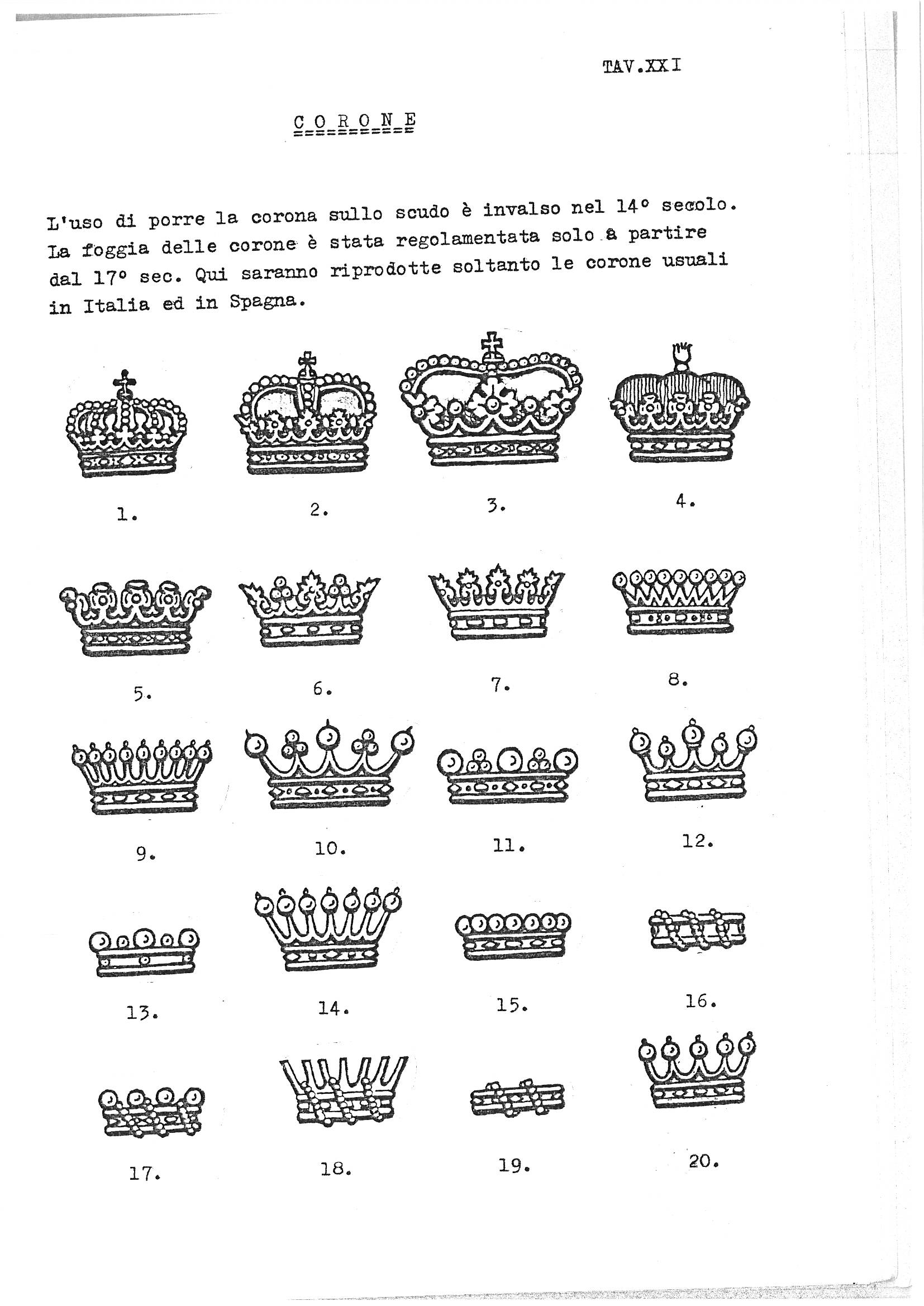
TAV.XXI
C O R O N E
L'uso di porre la corona sullo scudo è invalso nel 14° secolo.
La foggia delle corone è stata regolamentata solo a partire
dal 17° sec. Qui saranno riprodotte soltanto le corone usuali
in Italia ed in Spagna.
1.
2.
3.
4.
5.
6.
7.
8.
9.
10.
11.
12.
13.
14.
15.
16.
17.
18.
19.
20.
---
PLATE XXI
C O R O N E T S
The practice of placing a coronet above the shield became established in the 14th century.
The form of coronets was regulated only from the 17th century onwards. Here only the coronets
commonly used in Italy and Spain will be reproduced.
1.
2.
3.
4.
5.
6.
7.
8.
9.
10.
11.
12.
13.
14.
15.
16.
17.
18.
19.
20.
---
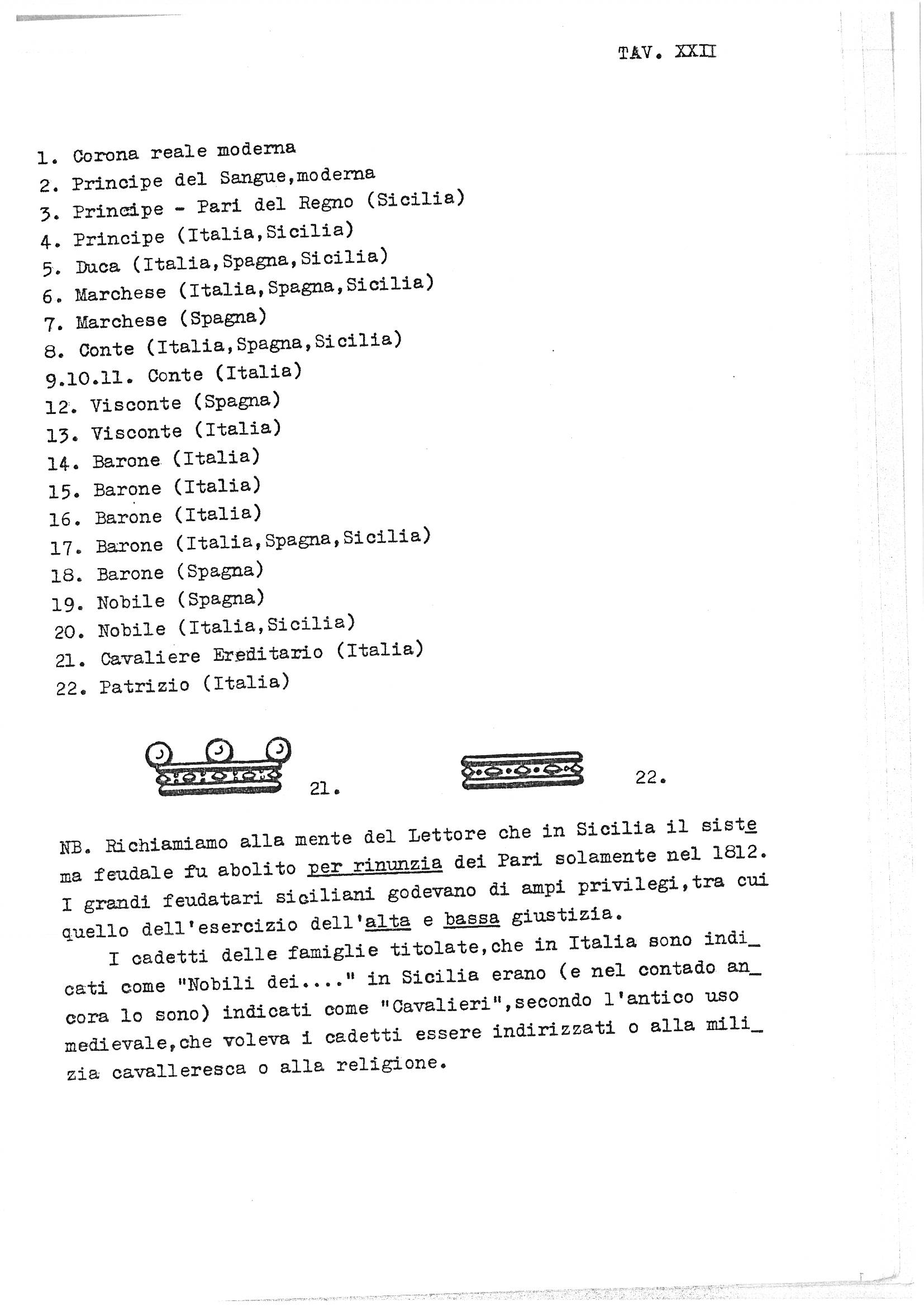
TAV. XXII
1. Corona reale moderna
2. Principe del Sangue,moderna
3. Principe - Pari del Regno (Sicilia)
4. Principe (Italia,Sicilia)
5. Duca (Italia,Spagna,Sicilia)
6. Marchese (Italia,Spagna,Sicilia)
7. Marchese (Spagna)
8. Conte (Italia,Spagna,Sicilia)
9.10.11. Conte (Italia)
12. Visconte (Spagna)
13. Visconte (Italia)
14. Barone (Italia)
15. Barone (Italia)
16. Barone (Italia)
17. Barone (Italia,Spagna,Sicilia)
18. Barone (Spagna)
19. Nobile (Spagna)
20. Nobile (Italia,Sicilia)
21. Cavaliere Ereditario (Italia)
22. Patrizio (Italia)
NB. Richiamiamo alla mente del Lettore che in Sicilia il siste_
ma feudale fu abolito per rinunzia dei Pari solamente nel 1812.
I grandi feudatari siciliani godevano di ampi privilegi,tra cui
quello dell'esercizio dell'alta e bassa giustizia.
I cadetti delle famiglie titolate,che in Italia sono indi_
cati come "Nobili dei...." in Sicilia erano (e nel contado an_
cora lo sono) indicati come "Cavalieri",secondo l'antico uso
medievale,che voleva i cadetti essere indirizzati o alla mili_
zia cavalleresca o alla religione.
---
PLATE XXII
1. Modern Royal Crown
2. Prince of the Blood, modern
3. Prince - Peer of the Realm (Sicily)
4. Prince (Italy, Sicily)
5. Duke (Italy, Spain, Sicily)
6. Marquess (Italy, Spain, Sicily)
7. Marquess (Spain)
8. Earl (Italy, Spain, Sicily)
9.10.11. Earl (Italy)
12. Viscount (Spain)
13. Viscount (Italy)
14. Baron (Italy)
15. Baron (Italy)
16. Baron (Italy)
17. Baron (Italy, Spain, Sicily)
18. Baron (Spain)
19. Noble (Spain)
20. Noble (Italy, Sicily)
21. Hereditary Knight (Italy)
22. Patrician (Italy)
N.B. We call to the Reader's mind that in Sicily the feudal sys-
tem was abolished by renunciation of the Peers only in 1812.
The great Sicilian feudatories enjoyed extensive privileges, among
which was that of the exercise of high and low justice.
The younger sons of titled families, who in Italy are desig-
nated as "Nobles of...." in Sicily were (and in the countryside
still are) designated as "Knights," according to the ancient
medieval usage, which held that younger sons be directed either to
chivalric warfare or to religion.
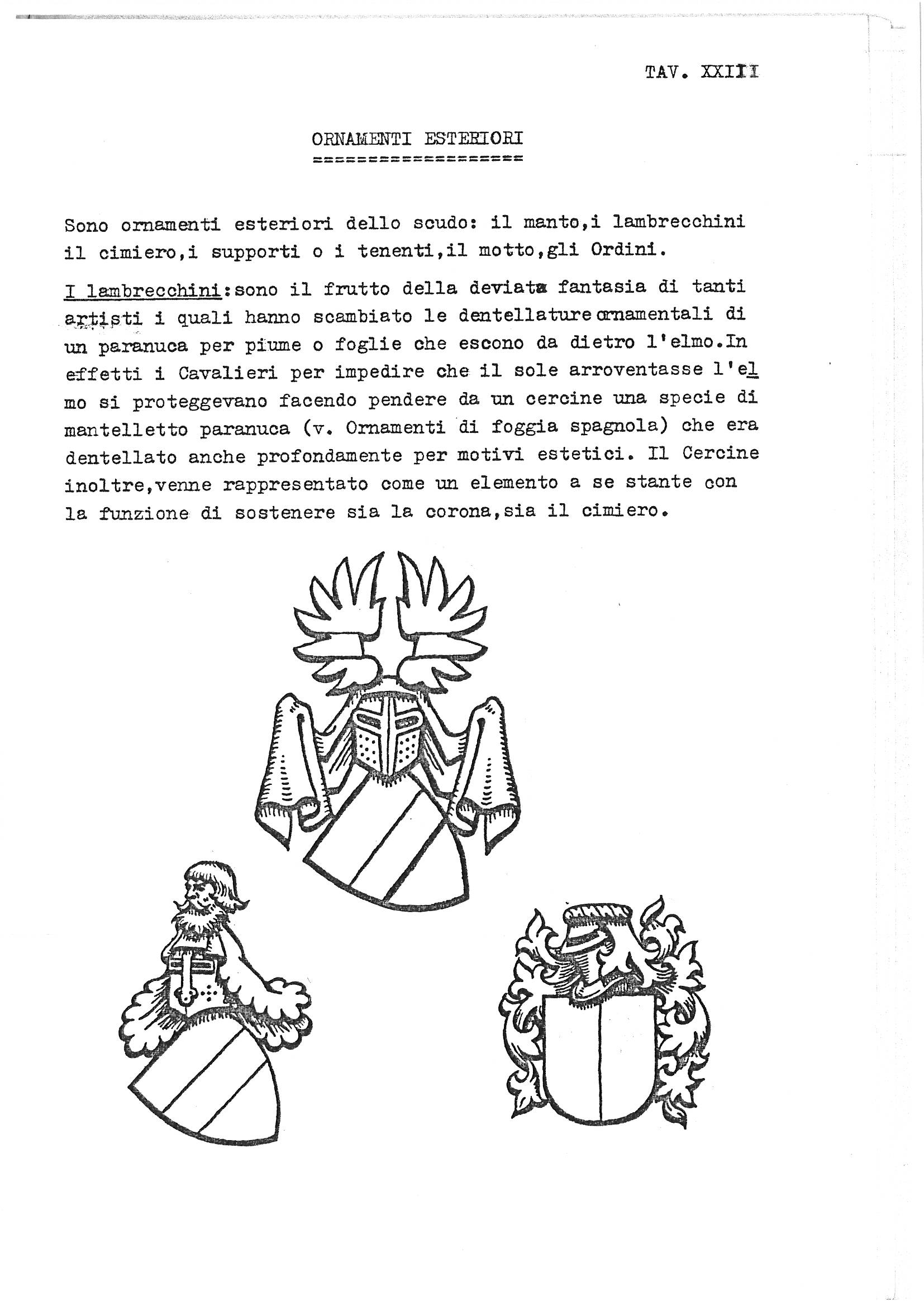
TAV. XXIII
ORNAMENTI ESTERIORI
==================
Sono ornamenti esteriori dello scudo: il manto,i lambrecchini
il cimiero,i supporti o i tenenti,il motto,gli Ordini.
I lambrecchini:sono il frutto della deviata fantasia di tanti
artisti i quali hanno scambiato le dentellature ornamentali di
un paranuca per piume o foglie che escono da dietro l'elmo.In
effetti i Cavalieri per impedire che il sole arroventasse l'el_
mo si proteggevano facendo pendere da un cercine una specie di
mantelletto paranuca (v. Ornamenti di foggia spagnola) che era
dentellato anche profondamente per motivi estetici. Il Cercine
inoltre,venne rappresentato come un elemento a se stante con
la funzione di sostenere sia la corona,sia il cimiero.
---
TAV. XXIII
EXTERIOR ORNAMENTS
==================
The exterior ornaments of the shield are: the mantling, the lambrequins,
the crest, the supporters or tenants, the motto, and the Orders.
The lambrequins: are the result of the wayward imagination of many
artists who mistook the ornamental dentilation of a mail-hood for feathers
or leaves emerging from behind the helm. In fact, Knights protected themselves
from the sun heating the helm by having a kind of mail-hood (v. Spanish-style
Ornaments) hang from a circlet, which was dentilated quite deeply for aesthetic
reasons. The circlet, moreover, came to be represented as a separate element
with the function of supporting both the crown and the crest.
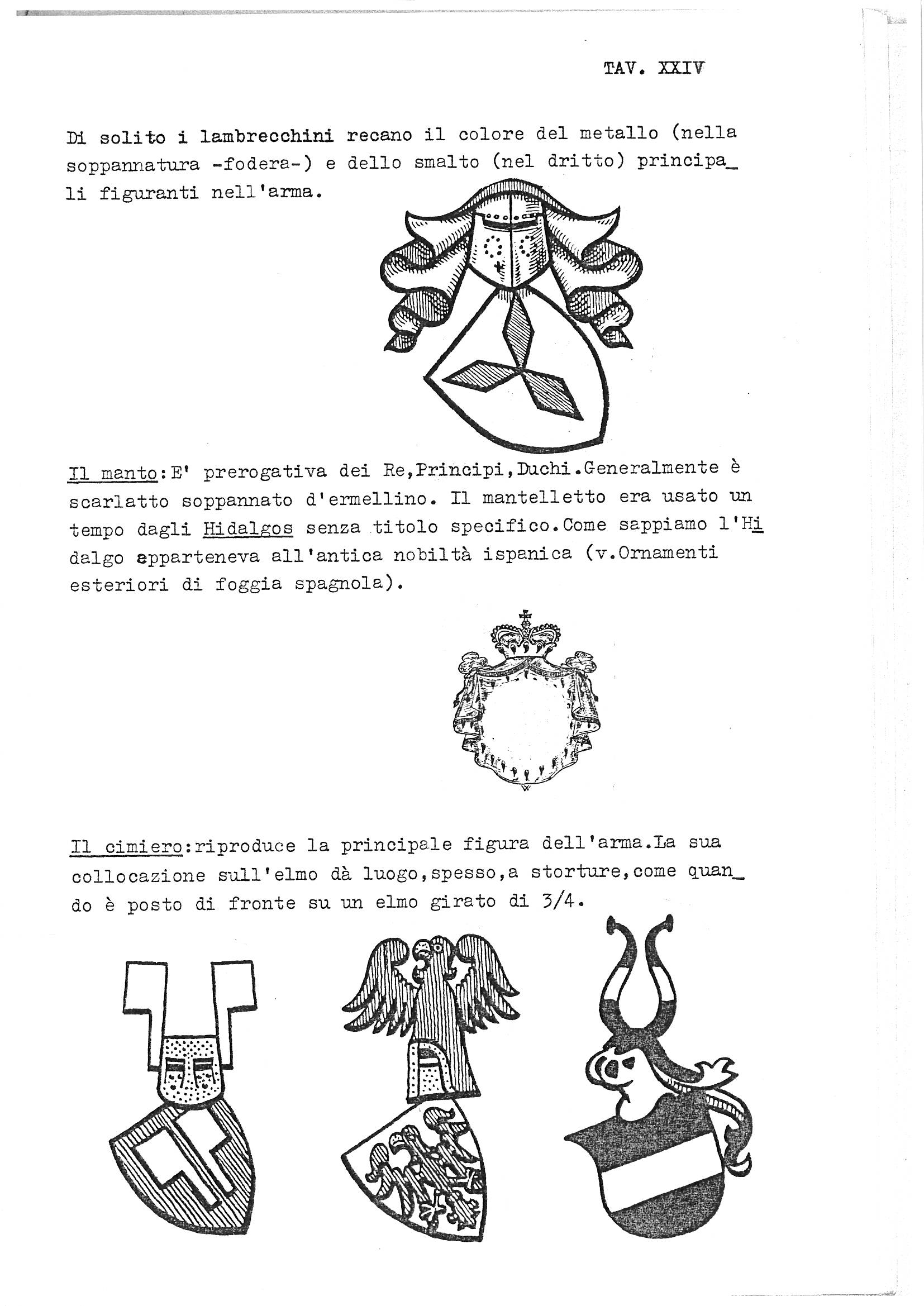
TAV. XXIV
Di solito i lambrecchini recano il colore del metallo (nella
soppannatura -fodera-) e dello smalto (nel dritto) principa_
li figuranti nell'arma.
Il manto: E' prerogativa dei Re, Principi, Duchi. Generalmente è
scarlatto soppannato d'ermellino. Il mantelletto era usato un
tempo dagli Hidalgos senza titolo specifico. Come sappiamo l'Hi_
dalgo apparteneva all'antica nobiltà ispanica (v. Ornamenti
esteriori di foggia spagnola).
Il cimiero: riproduce la principale figura dell'arma. La sua
collocazione sull'elmo dà luogo, spesso, a storture, come quan_
do è posto di fronte su un elmo girato di 3/4.
---
PLATE XXIV
The mantling usually bears the color of the metal (in the lining) and of the tincture (in the outer surface) that are the principal ones appearing in the arms.
The Mantle: It is the prerogative of Kings, Princes, and Dukes. Generally it is scarlet lined with ermine. The mantlet was used in former times by Hidalgos without specific title. As we know, the Hidalgo belonged to the ancient Hispanic nobility (see Exterior Ornaments of Spanish Fashion).
The Crest: it reproduces the principal figure of the arms. Its placement upon the helm often gives rise to distortions, such as when it is positioned facing forward upon a helm turned three-quarters.
TAV. XXV
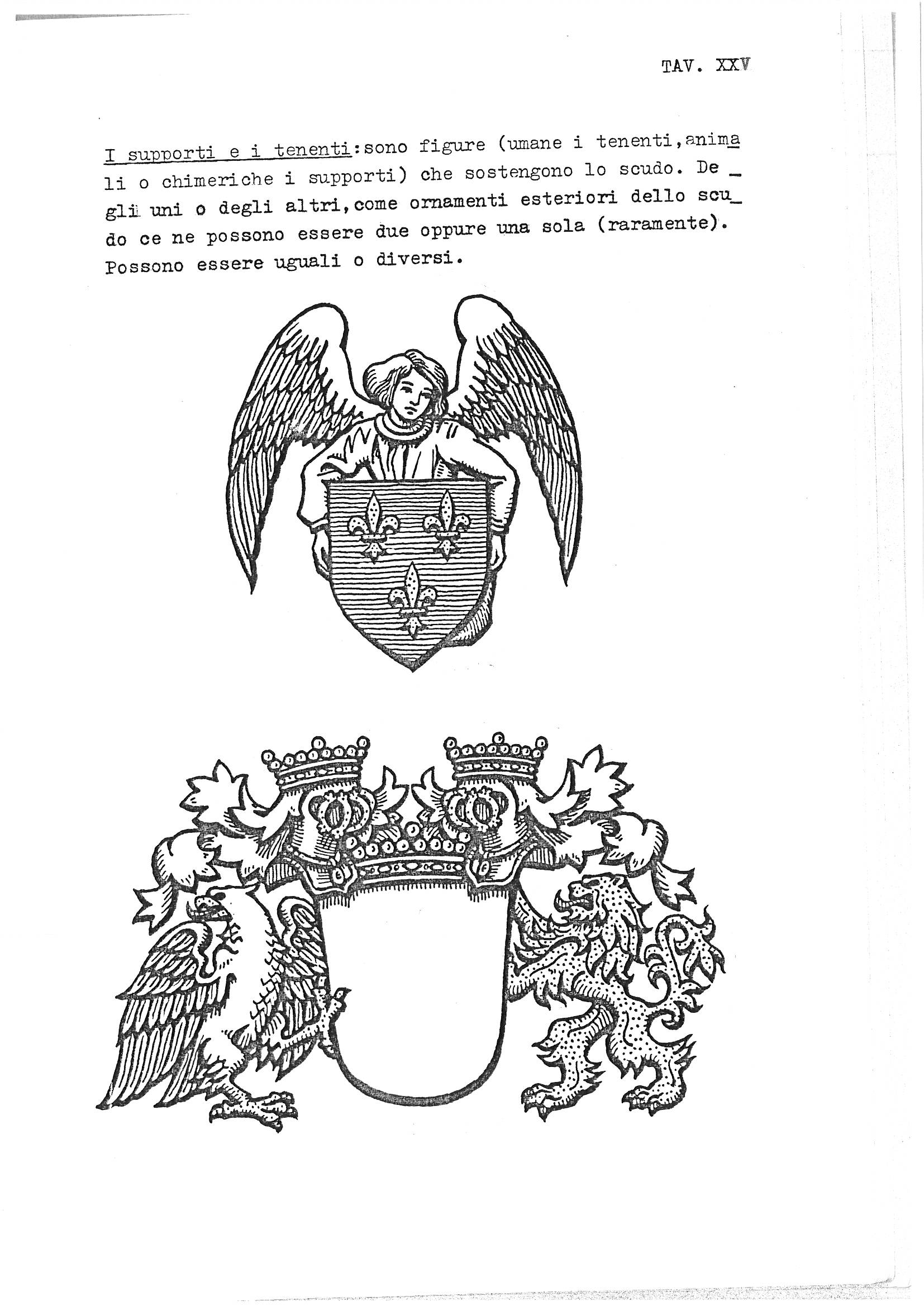
I supporti e i tenenti:sono figure (umane i tenenti,anima_
li o chimeriche i supporti) che sostengono lo scudo. De_
gli uni o degli altri,come ornamenti esteriori dello scu_
do ce ne possono essere due oppure una sola (raramente).
Possono essere uguali o diversi.
TAV. XXV
Supporters and supporters: these are figures (human ones are supporters, animals or chimeric creatures are supporters) that bear the shield. Of one or the other, as exterior ornaments of the shield, there can be two or just one (rarely). They can be identical or different.
---
**Note:** There appears to be a terminology issue in the original Italian text itself—both "i tenenti" and "i supporti" are being defined somewhat inconsistently. A more precise translation reflecting the intended heraldic distinction would be:
Supporters and supporters: these are figures (human figures are called supporters, while animals or chimeric creatures are called supporters) that bear the shield. Of one or the other, as exterior ornaments of the shield, there can be two or just one (rarely). They can be identical or different.
However, if the original text intended to distinguish between "tenenti" (supporters—typically human) and "supporti" (supporters—typically animals/chimeras), the translation would need clarification from the source material.
TAV. XXVI
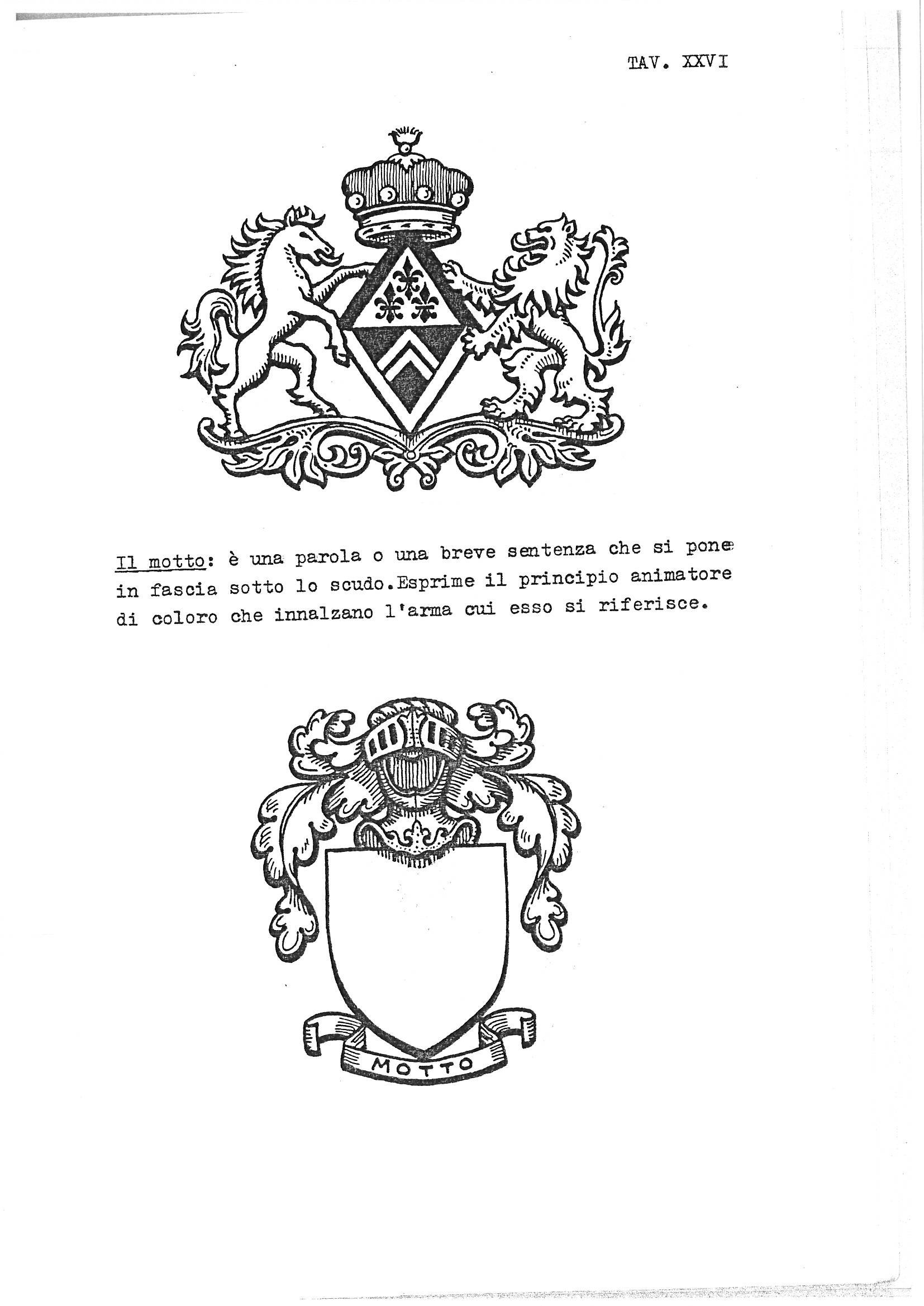
Il motto: è una parola o una breve sentenza che si pone
in fascia sotto lo scudo. Esprime il principio animatore
di coloro che innalzano l'arma cui esso si riferisce.
---
TAV. XXVI
The motto: is a word or a brief sentence that is placed
in a fess beneath the shield. It expresses the animating principle
of those who bear the arms to which it refers.
TAV. XXVII
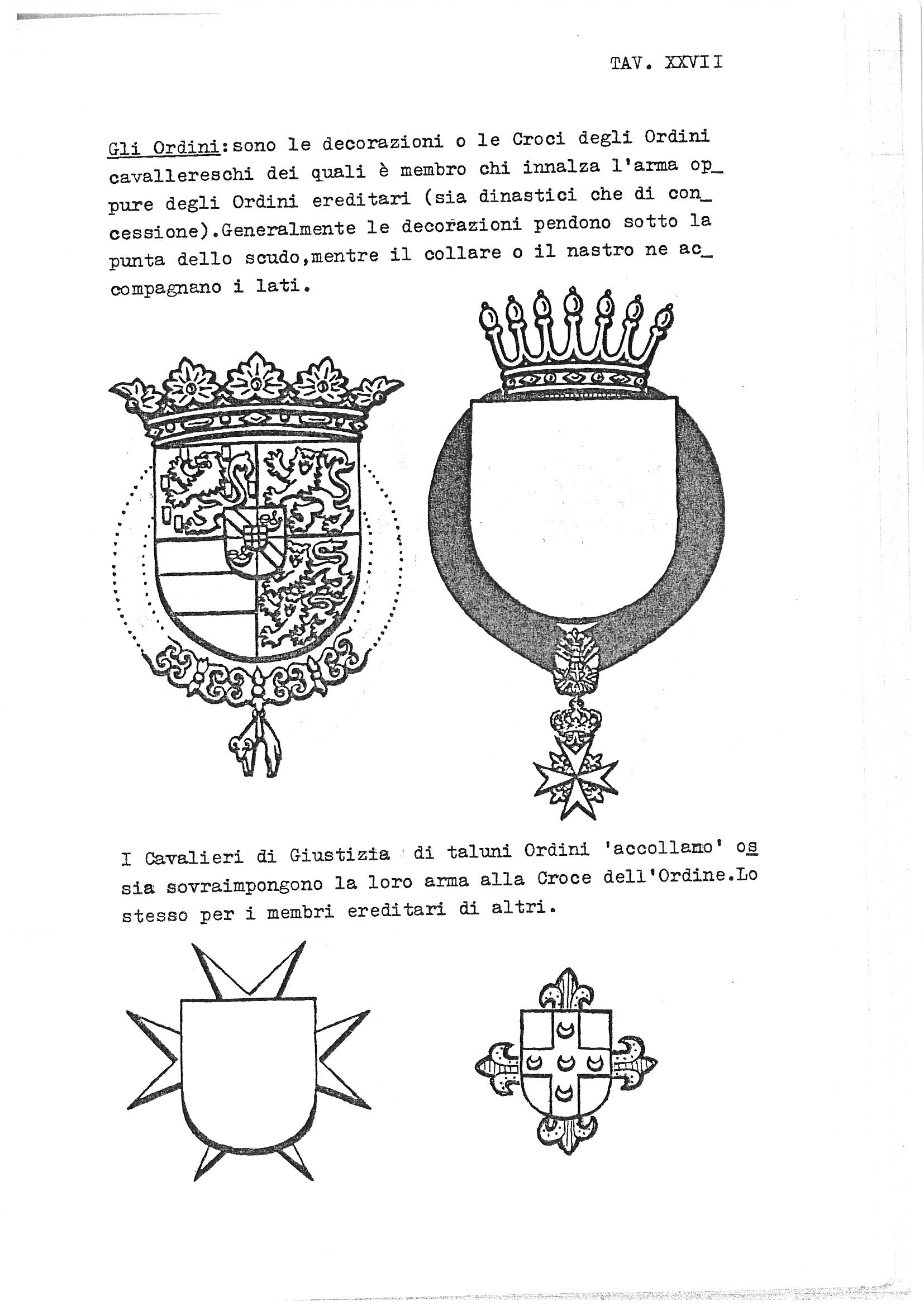
Gli Ordini:sono le decorazioni o le Croci degli Ordini
cavallereschi dei quali è membro chi innalza l'arma op_
pure degli Ordini ereditari (sia dinastici che di con_
cessione).Generalmente le decorazioni pendono sotto la
punta dello scudo,mentre il collare o il nastro ne ac_
compagnano i lati.
I Cavalieri di Giustizia di taluni Ordini 'accollano' os_
sia sovraimpongono la loro arma alla Croce dell'Ordine.Lo
stesso per i membri ereditari di altri.
---
TAV. XXVII
Orders: these are the decorations or Crosses of chivalric Orders of which the bearer of the arms is a member, or of hereditary Orders (whether dynastic or by grant). Generally the decorations hang below the point of the shield, while the collar or ribbon accompany its sides.
Knights of Justice of certain Orders 'accoll' or superimpose their arms upon the Cross of the Order. The same applies to hereditary members of others.
TAV.XXVIII
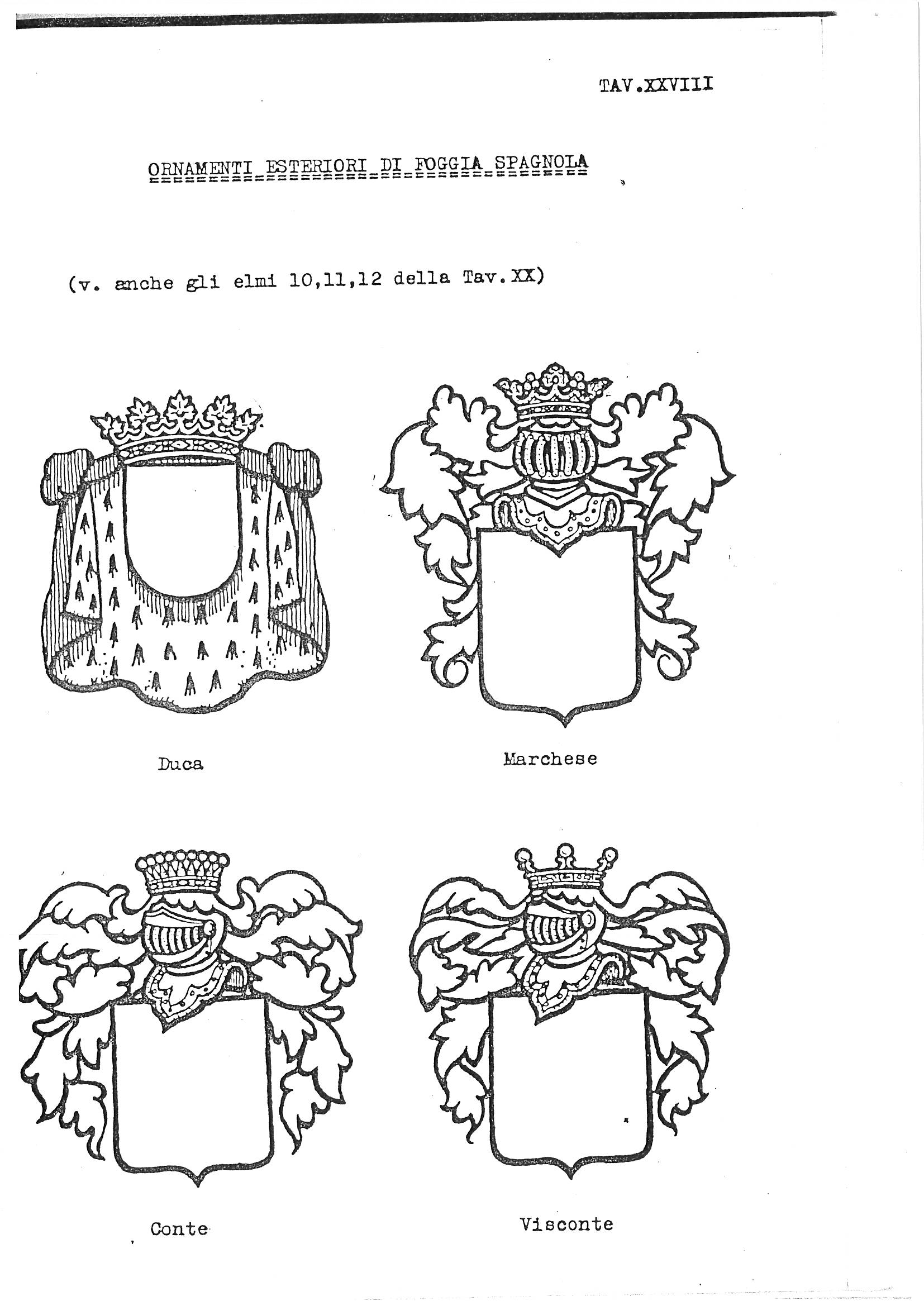
ORNAMENTI ESTERIORI DI FOGGIA SPAGNOLA
(v. anche gli elmi 10,11,12 della Tav.XX)
Duca
Marchese
Conte
Visconte
---
TAV.XXVIII
EXTERIOR ORNAMENTS OF SPANISH FASHION
(see also helms 10, 11, 12 of Pl.XX)
Duke
Marquess
Count
Viscount
---
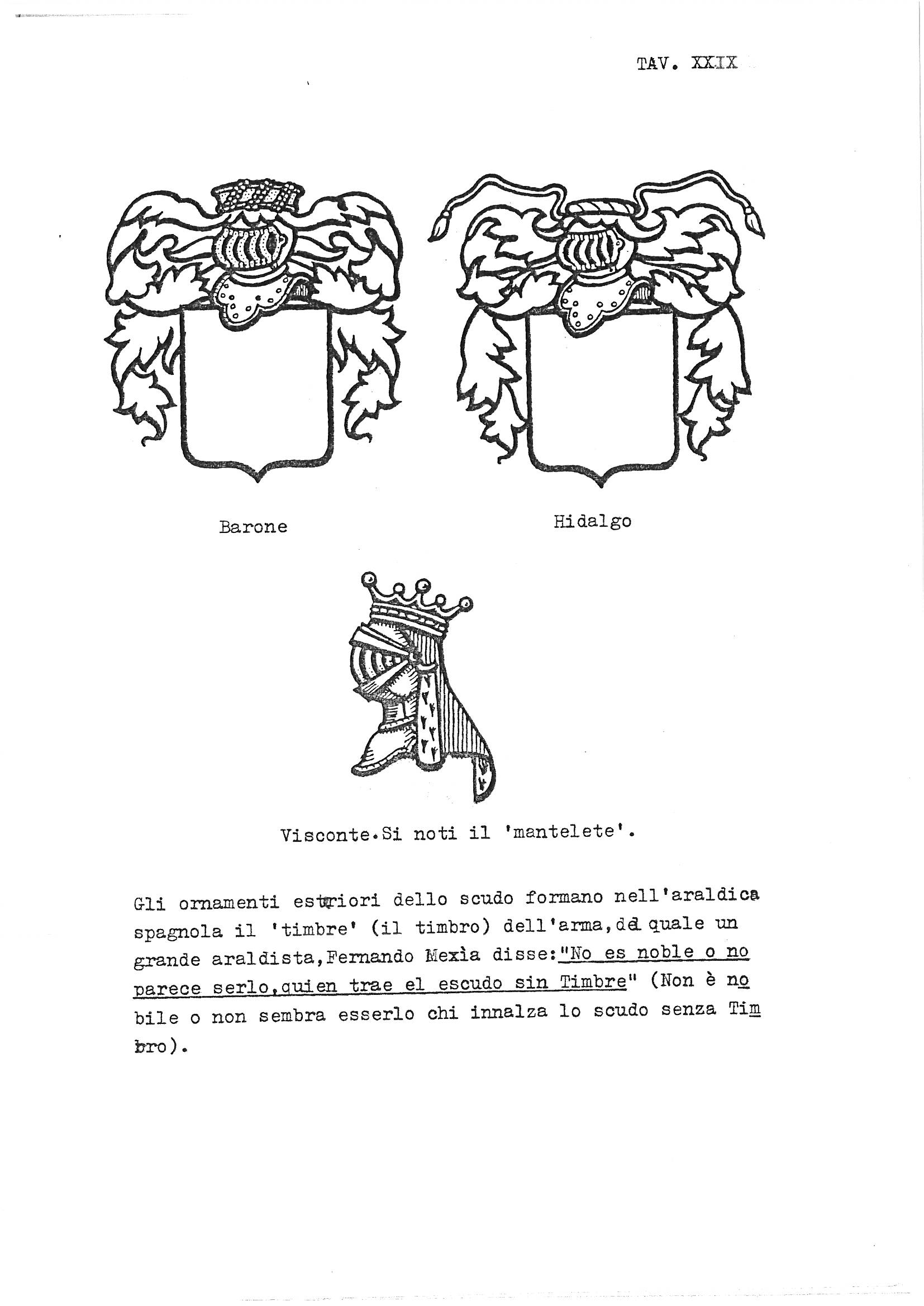
TAV. XXIX
Barone
Hidalgo
Visconte.Si noti il 'mantelete'.
Gli ornamenti esteriori dello scudo formano nell'araldica
spagnola il 'timbre' (il timbro) dell'arma,dd quale un
grande araldista,Fernando Mexìa disse:"No es noble o no
parece serlo,quien trae el escudo sin Timbre" (Non è no_
bile o non sembra esserlo chi innalza lo scudo senza Tim_
bro).
---
PLATE XXIX
Baron
Hidalgo
Viscount. Note the 'mantelé'.
The exterior ornaments of the shield form in Spanish heraldry the 'timbre' (the achievement) of the arms, of which a great heraldist, Fernando Mexía, said: "No es noble o no parece serlo, quien trae el escudo sin Timbre" (He is not noble, or does not appear to be so, who displays the shield without Timbre).
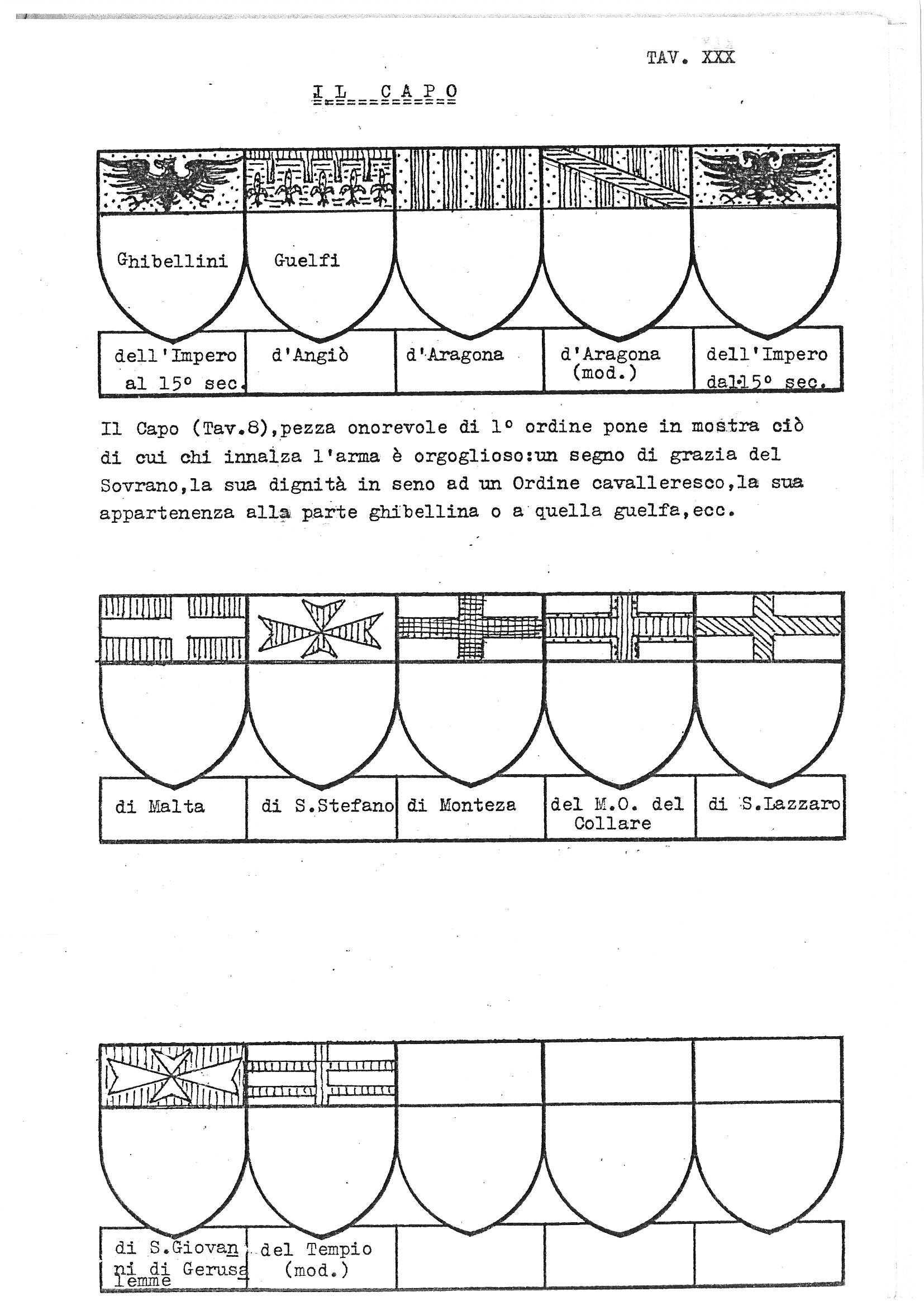
TAV. XXX
IL CAPO
Ghibellini
Guelfi
dell'Impero
al 15° sec.
d'Angiò
d'Aragona
d'Aragona
(mod.)
dell'Impero
dal 15° sec.
Il Capo (Tav.8),pezza onorevole di 1° ordine pone in mostra ciò
di cui chi innalza l'arma è orgoglioso:un segno di grazia del
Sovrano,la sua dignità in seno ad un Ordine cavalleresco,la sua
appartenenza alla parte ghibellina o a quella guelfa,ecc.
di Malta
di S.Stefano
di Montesa
del M.O. del
Collare
di S.Lazzaro
di S.Giovanni
di Gerusa-
lemme
del Tempio
(mod.)
---
PLATE XXX
THE CHIEF
Ghibellines
Guelphs
of the Empire
15th century
of Anjou
of Aragon
of Aragon
(mod.)
of the Empire
from the 15th century
The Chief (Pl. 8), an honorable ordinary of the first order, displays that of which the bearer of the arms is proud: a sign of the Sovereign's grace, his dignity within a knightly Order, his allegiance to the Ghibelline or Guelph faction, etc.
of Malta
of St. Stephen
of Montesa
of the Grand Master of the
Collar
of St. Lazarus
of St. John
of Jeru-
salem
of the Temple
(mod.)
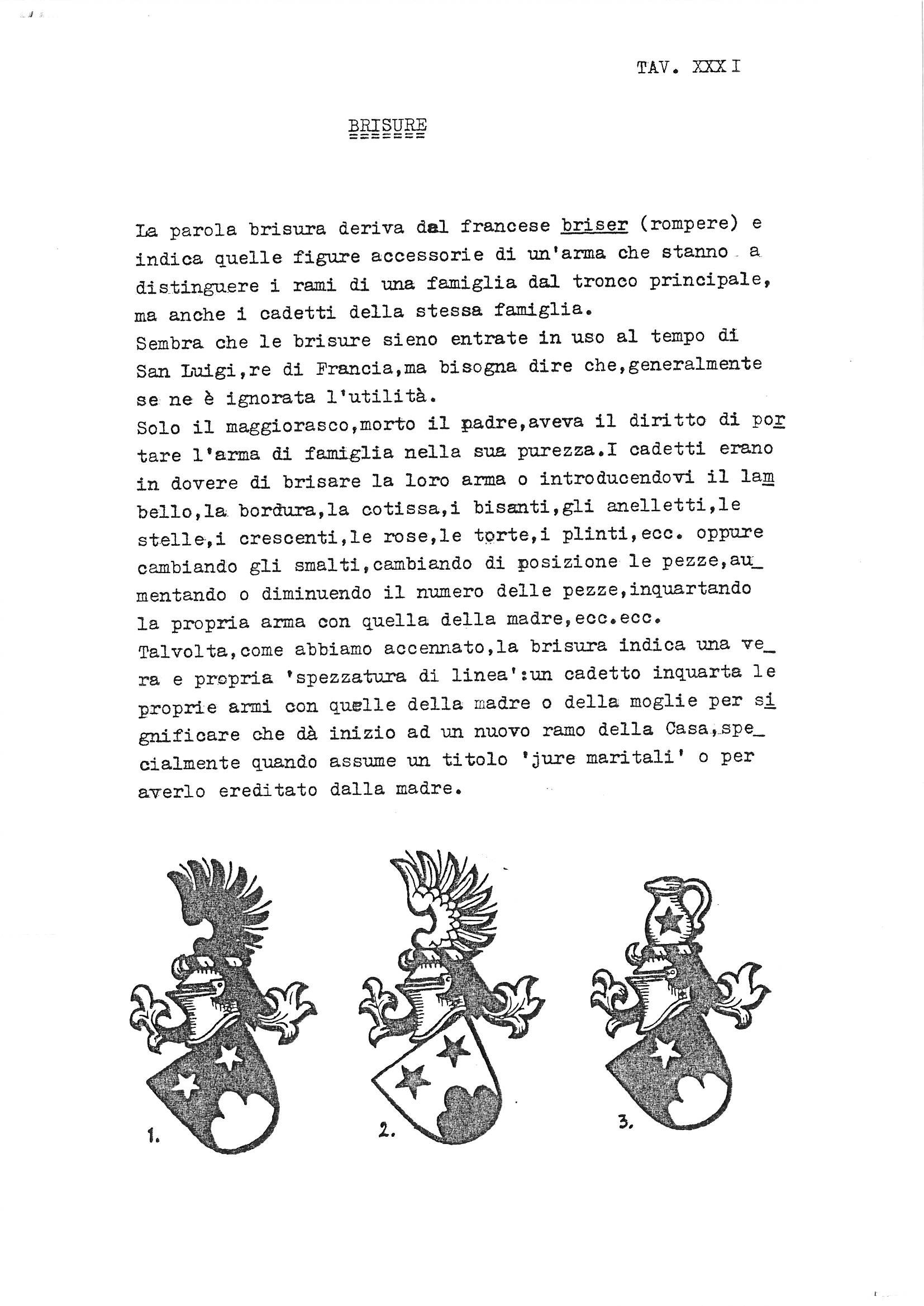
TAV. XXXI
BRISURE
La parola brisura deriva dal francese briser (rompere) e indica quelle figure accessorie di un'arma che stanno a distinguere i rami di una famiglia dal tronco principale, ma anche i cadetti della stessa famiglia.
Sembra che le brisure sieno entrate in uso al tempo di San Luigi,re di Francia,ma bisogna dire che,generalmente se ne è ignorata l'utilità.
Solo il maggiorasco,morto il padre,aveva il diritto di portare l'arma di famiglia nella sua purezza.I cadetti erano in dovere di brisare la loro arma o introducendovi il lam bello,la bordura,la cotissa,i bisanti,gli anelletti,le stelle,i crescenti,le rose,le torte,i plinti,ecc. oppure cambiando gli smalti,cambiando di posizione le pezze,au_mentando o diminuendo il numero delle pezze,inquartando la propria arma con quella della madre,ecc.ecc.
Talvolta,come abbiamo accennato,la brisura indica una ve_ ra e propria 'spezzatura di linea':un cadetto inquarta le proprie armi con quelle della madre o della moglie persignificare che dà inizio ad un nuovo ramo della Casa,spe_ cialmente quando assume un titolo 'jure maritali' o per averlo ereditato dalla madre.
PLATE XXXI
BRISURES
The word brisure derives from the French briser (to break) and indicates those accessory figures of an arms which serve to distinguish the branches of a family from the main line, but also the cadets of the same family.
It appears that brisures came into use in the time of Saint Louis, King of France, but it must be said that, generally, their utility was ignored.
Only the heir, upon the death of his father, had the right to bear the family arms in their purity. The cadets were obliged to brisure their arms either by introducing a label, a bordure, a cotise, besants, annulets, stars, crescents, roses, torteaux, plinths, etc., or by changing the tinctures, by changing the position of the charges, by increasing or diminishing the number of the charges, by quartering their own arms with those of the mother, etc. etc.
Sometimes, as we have mentioned, the brisure indicates a true and proper 'breaking of line': a cadet quarters his own arms with those of the mother or of the wife in order to signify that he is founding a new branch of the House, especially when he assumes a title 'jure maritali' or by having inherited it from his mother.
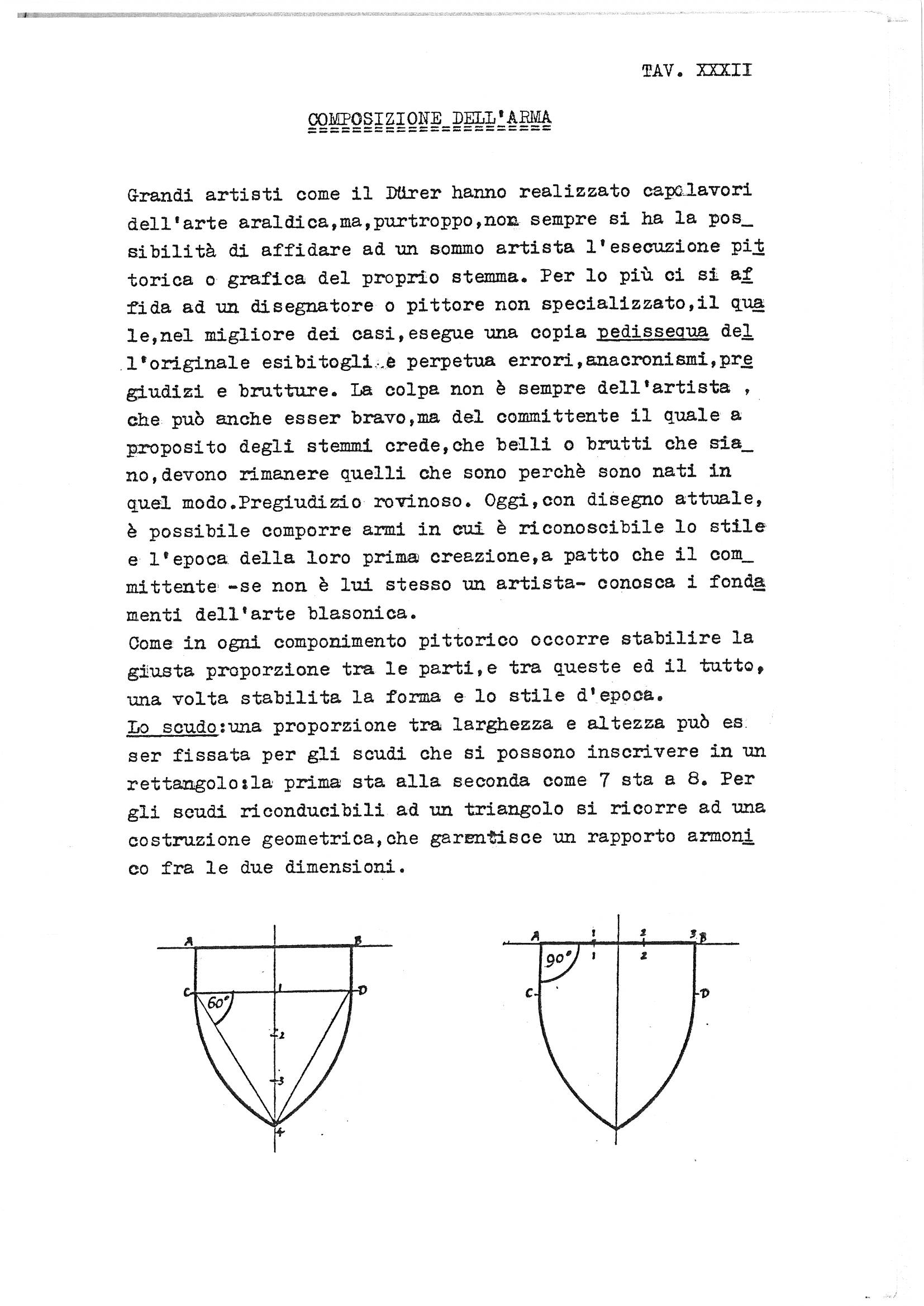
TAV. XXXII
COMPOSIZIONE DELL'ARMA
Grandi artisti come il Dürer hanno realizzato capolavori
dell'arte araldica,ma,purtroppo,non sempre si ha la pos_
sibilità di affidare ad un sommo artista l'esecuzione pit_
torica o grafica del proprio stemma. Per lo più ci si af_
fida ad un disegnatore o pittore non specializzato,il qua_
le,nel migliore dei casi,esegue una copia pedissequa del_
l'originale esibitogli e perpetua errori,anacronismi,pre_
giudizi e brutture. La colpa non è sempre dell'artista ,
che può anche esser bravo,ma del committente il quale a
proposito degli stemmi crede,che belli o brutti che sia_
no,devono rimanere quelli che sono perchè sono nati in
quel modo.Pregiudizio rovinoso. Oggi,con disegno attuale,
è possibile comporre armi in cui è riconoscibile lo stile
e l'epoca della loro prima creazione,a patto che il com_
mittente -se non è lui stesso un artista- conosca i fonda_
menti dell'arte blasonica.
Come in ogni componimento pittorico occorre stabilire la
giusta proporzione tra le parti,e tra queste ed il tutto,
una volta stabilita la forma e lo stile d'epoca.
Lo scudo:una proporzione tra larghezza e altezza può es_
ser fissata per gli scudi che si possono inscrivere in un
rettangolo:la prima sta alla seconda come 7 sta a 8. Per
gli scudi riconducibili ad un triangolo si ricorre ad una
costruzione geometrica,che garantisce un rapporto armoni_
co fra le due dimensioni.
---
PLATE XXXII
COMPOSITION OF THE COAT OF ARMS
Great artists such as Dürer have created masterpieces of heraldic art, but unfortunately it is not always possible to entrust the pictorial or graphic execution of one's coat of arms to a supreme artist. For the most part one relies on a draftsman or painter who is not a specialist, who, in the best of cases, executes a servile copy of the original shown to him and perpetuates errors, anachronisms, prejudices, and defects. The fault is not always that of the artist, who may also be skilled, but of the patron, who concerning coats of arms believes that, beautiful or ugly as they may be, they must remain as they are because they were created that way. A ruinous prejudice. Today, with contemporary design, it is possible to compose arms in which the style and period of their original creation are recognizable, provided that the patron—if he is not himself an artist—knows the fundamentals of heraldic art.
As in every pictorial composition, it is necessary to establish the correct proportion between the parts, and between these and the whole, once the form and style of the period have been determined.
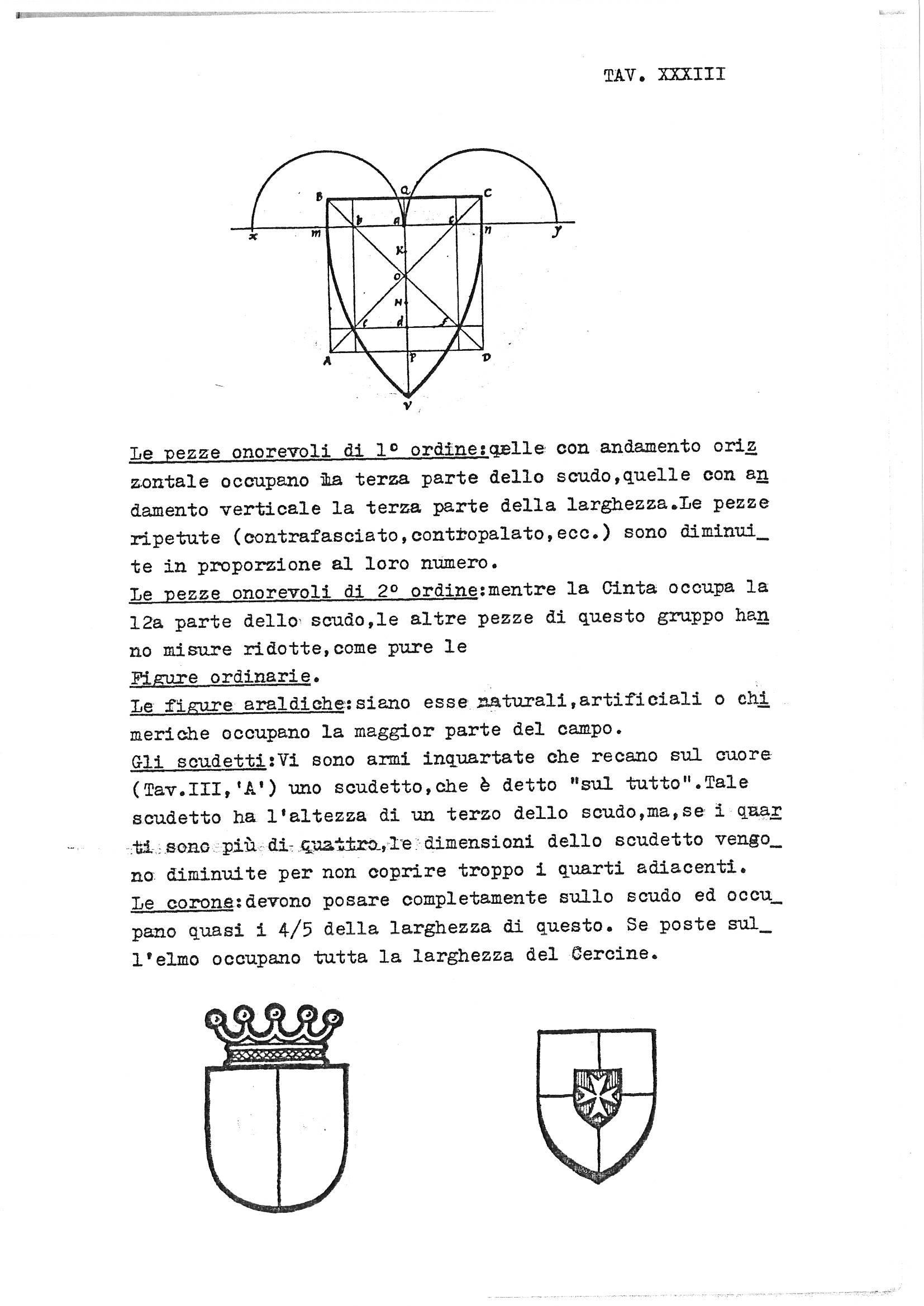
The shield: a proportion between width and height can be established for shields that can be inscribed in a rectangle: the first is to the second as 7 is to 8. For shields that can be reduced to a triangle, one resorts to a geometric construction, which guarantees a harmonious relationship between the two dimensions.
TAV. XXXIII
Le pezze onorevoli di 1° ordine:qelle con andamento oriz_
zontale occupano la terza parte dello scudo,quelle con an_
damento verticale la terza parte della larghezza.Le pezze
ripetute (contrafasciato,contropalato,ecc.) sono diminui_
te in proporzione al loro numero.
Le pezze onorevoli di 2° ordine:mentre la Cinta occupa la
12a parte dello scudo,le altre pezze di questo gruppo han_
no misure ridotte,come pure le
Figure ordinarie.
Le figure araldiche:siano esse naturali,artificiali o chi_
meriche occupano la maggior parte del campo.
Gli scudetti:Vi sono armi inquartate che recano sul cuore
(Tav.III,'A') uno scudetto,che è detto "sul tutto".Tale
scudetto ha l'altezza di un terzo dello scudo,ma,se i quar_
ti sono più di quattro,le dimensioni dello scudetto vengo_
no diminuite per non coprire troppo i quarti adiacenti.
Le corone:devono posare completamente sullo scudo ed occu_
pano quasi i 4/5 della larghezza di questo. Se poste sul_
l'elmo occupano tutta la larghezza del Cercine.
---
TAV. XXXIII
The honourable charges of 1st order: those with horizontal disposition occupy one third of the shield, those with vertical disposition occupy one third of the width. The repeated charges (counter-fesswise, counter-paleways, etc.) are diminished in proportion to their number.
The honourable charges of 2nd order: whilst the Orle occupies the 1/12th part of the shield, the other charges of this group have reduced dimensions, as do the
Ordinary figures.
The heraldic figures: whether they be natural, artificial or chimerical, occupy the greater part of the field.
The escutcheons: There are quarterly arms that bear upon the heart (Plate III, 'A') an escutcheon, which is called "over all". This escutcheon has the height of one third of the shield, but, if the quarters are more than four, the dimensions of the escutcheon are diminished so as not to cover too much the adjacent quarters.
The crowns: must rest completely upon the shield and occupy almost 4/5 of its width. If placed upon the helm, they occupy the entire width of the Wreath.
TAV. XXXIV
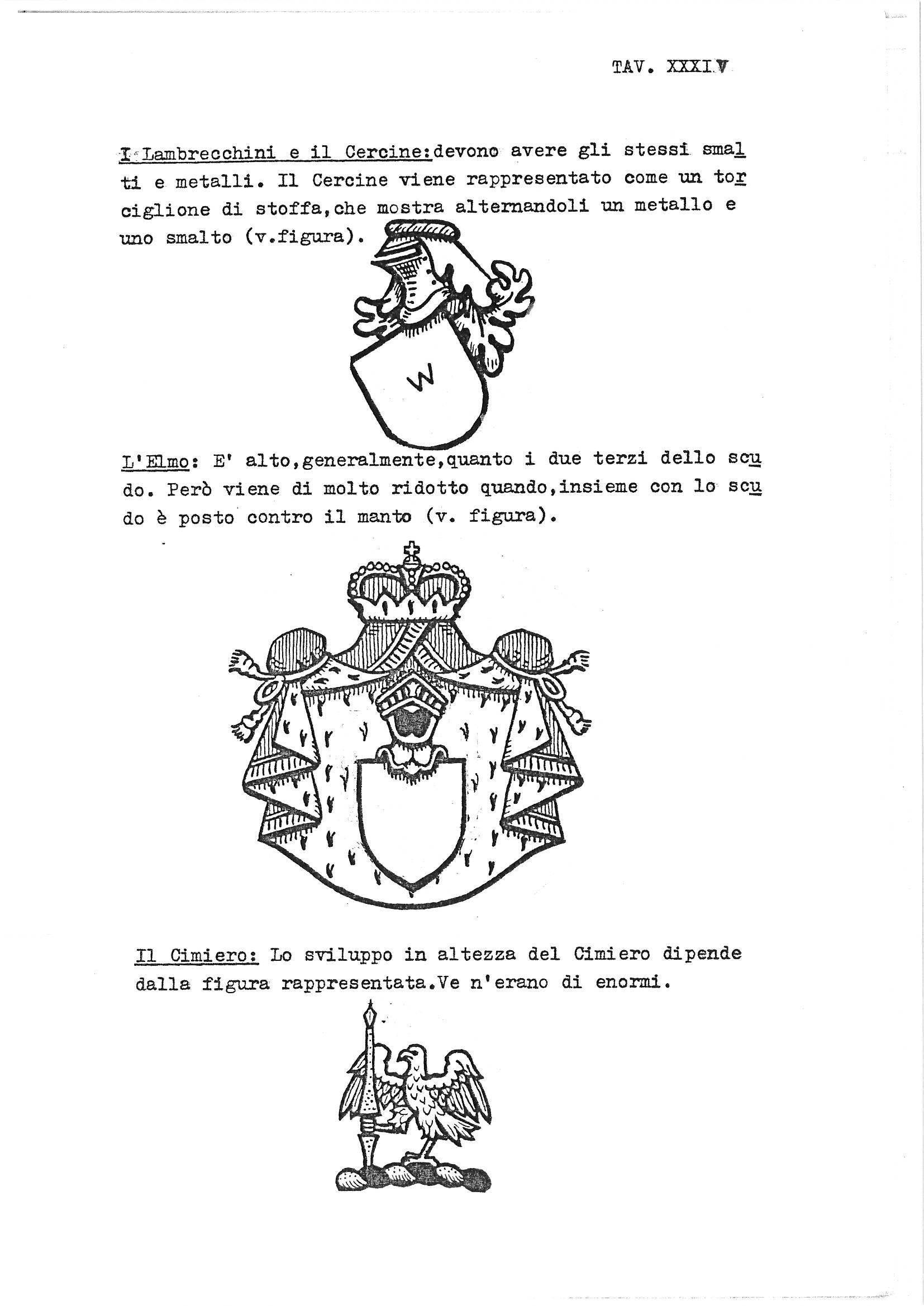
I Lambrecchini e il Cercine:devono avere gli stessi smal_
ti e metalli. Il Cercine viene rappresentato come un tor_
ciglione di stoffa,che mostra alternandoli un metallo e
uno smalto (v.figura).
L'Elmo: E' alto,generalmente,quanto i due terzi dello scu_
do. Però viene di molto ridotto quando,insieme con lo scu_
do è posto contro il manto (v. figura).
Il Cimiero: Lo sviluppo in altezza del Cimiero dipende
dalla figura rappresentata.Ve n'erano di enormi.
---
TAV. XXXIV
The Mantling and the Wreath: they must have the same tinctures and metals. The Wreath is represented as a twisted roll of fabric, which displays alternately a metal and a tincture (see figure).
The Helm: It is tall, generally, as two thirds of the shield. However, it is greatly reduced in size when, together with the shield, it is placed against the mantle (see figure).
The Crest: The vertical development of the Crest depends on the figure represented. There were some of enormous size.
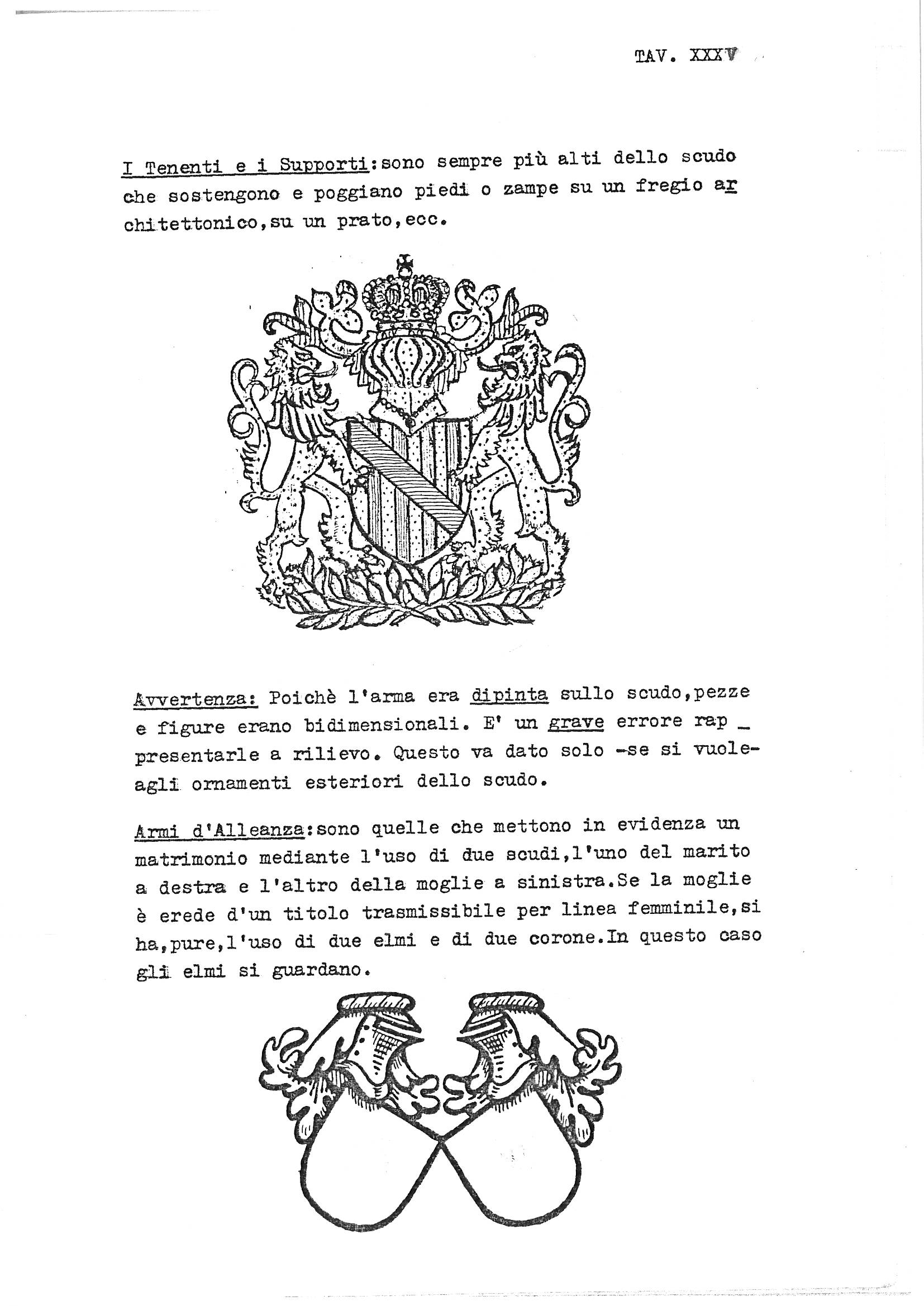
I Tenenti e i Supporti sono sempre più alti dello scudo che sostengono e poggiano piedi o zampe su un fregio ar chitettonico,su un prato,ecc.
Avvertenza: Poichè l'arma era dipinta sullo scudo,pezze e figure erano bidimensionali. E' un grave errore rap presentarle a rilievo. Questo va dato solo -se si vuole- agli ornamenti esteriori dello scudo.
Armi d'Alleanza: sono quelle che mettono in evidenza un matrimonio mediante l'uso di due scudi,l'uno del marito a destra e l'altro della moglie a sinistra.Se la moglie è erede d'un titolo trasmissibile per linea femminile,si ha,pure,l'uso di due elmi e di due corone.In questo caso gli elmi si guardano.
Tenants and Supporters are always taller than the shield which they bear, and they rest their feet or paws upon an architectural ornament, a ground, etc.
Note: Since the arms were painted upon the shield, the charges and figures were two-dimensional. It is a grave error to represent them in relief. This should be given only—if desired—to the external ornaments of the shield.
Arms of Alliance: these are arms that highlight a marriage through the use of two shields, that of the husband on the dexter and that of the wife on the sinister. If the wife is an heiress of a title transmissible through the female line, there is also the use of two helms and two coronets. In this case the helms face one another.
TAV. XXXVI
LA BLASONATURA
==============
L'insieme formato dallo scudo e dai suoi ornamenti este_
riori è chiamato dai Francesi 'blason'.Il descrivere un
blasone si dice 'blasonner',tradotto dagli araldisti Ita_
liani con 'blasonatura',orribile francesismo che ha oltre_
passato anche la Manica tanto che gl'Inglesi usano l'equi_
valente termine di 'blazing'.
La blasonatura è,quindi,la lettura dell'arma gentilizia
nelle sue varie componenti e va fatta usando il linguag_
gio proprio dell'araldica,che è una delle scienze ausilia_
rie della storia,al pari della diplomatica,sfragistica ,
genealogia.
La lettura comincia dall'arma spiegata nello scudo:
a) se ne enunciano le partizioni,se ce ne sono;
b) se l'arma è composta di quarti si procede nel loro or_
dine,descrivendo il 1° quarto,poi il 2°,il 3° e così
via.Nel caso,frequente,di quarti duplicati,questi si
descriveranno una sola volta con l'indicazione degli
ordinali cui il quarto si riferisce;
c) dell'arma (o del quarto) si descrive il metallo,lo
smalto o la pelliccia del campo,indi si descrivono le
pezze o le figure con i loro attibuti,metalli,smalti,
pellicce,numero e disposizione (sempre seguendo l'or_
dine delle partizioni:Tav.VII);
d) si descrivono gli scudetti,e per ultimo quello "sul
tutto";
e) ed infine il Capo principale,cioè quello che nello
scudo,comprendente due quarti o più,prende tutta la
larghezza dello scudo.
f) Si passa alla descrizione del 'timbro':corona,elmo ,
lambrecchini,Ordini,supporti o tenenti,motto.
E' ovvio che la complessità della blasonatura aumenta con
la complessità dell'arma. Il timbro,infatti,può include_
re insegne di dignità o di carica militare,civile,reli_
giosa,bandiere,stendardi,pennoni,armi,mazze ecc. ecc. e
tutte quante vanno descritte con chiarezza e proprietà.
PLATE XXXVI
THE BLAZON
==========
The ensemble formed by the shield and its external ornaments is called 'blason' by the French. To describe a blazon is said to be 'blasonner', translated by Italian heraldists as 'blasonatura', a dreadful Gallicism that has even crossed the Channel, such that the English use the equivalent term 'blazing'.
The blazon is, therefore, the reading of the coat of arms in its various components and must be conducted using the language proper to heraldry, which is one of the auxiliary sciences of history, on a par with diplomatics, sphragistics, and genealogy.
The reading begins with the arms displayed in the shield:
a) its partitions are first stated, if any exist;
b) if the arms are composed of quarters, one proceeds in their order, describing the 1st quarter, then the 2nd, the 3rd, and so forth. In the frequent case of duplicate quarters, these shall be described only once with an indication of the ordinal numbers to which the quarter refers;
c) of the arms (or of the quarter), one describes the metal, the tincture, or the fur of the field, then describes the charges or the figures with their attributes, metals, tinctures, furs, number and disposition (always following the order of the partitions: Plate VII);
d) one describes the escutcheons, and lastly that "over all";
e) and finally the Chief principal, that is to say that which in the shield, comprising two quarters or more, takes the entire width of the shield.
f) One proceeds to the description of the 'achievement': crown, helm, mantling, Orders, supporters, motto.
It is obvious that the complexity of the blazon increases with the complexity of the arms. The achievement, indeed, may include insignia of dignity or of military, civil, or religious rank, flags, standards, pennons, weapons, maces, etc., and all of these must be described with clarity and precision.
TAV. XXXVII
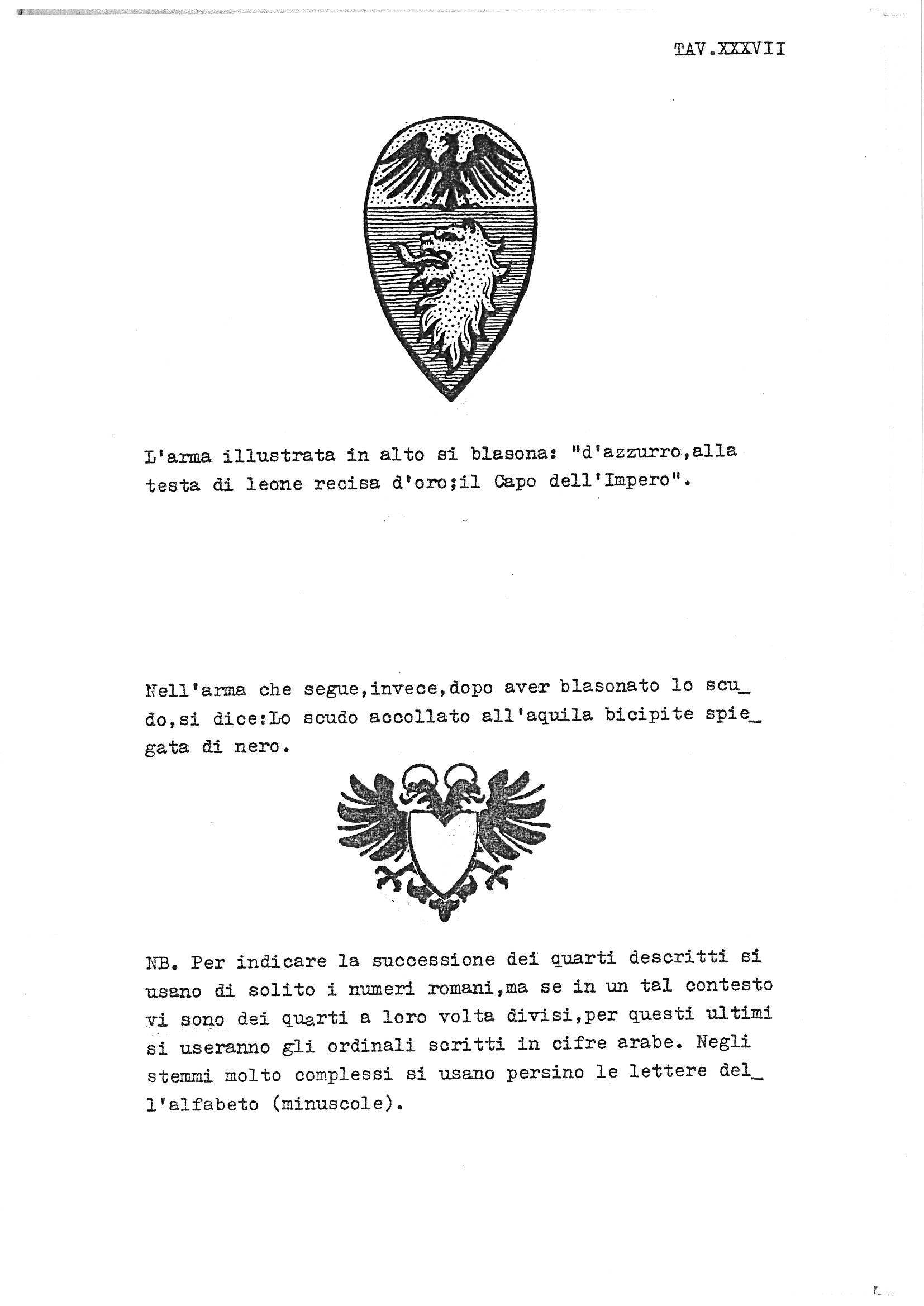
L'arma illustrata in alto si blasona: "d'azzurro,alla testa di leone recisa d'oro;il Capo dell'Impero".
Nell'arma che segue,invece,dopo aver blasonato lo scudo,si dice:lo scudo accollato all'aquila bicipite spie_gata di nero.
NB. Per indicare la successione dei quarti descritti si usano di solito i numeri romani,ma se in un tal contesto vi sono dei quarti a loro volta divisi,per questi ultimi si useranno gli ordinali scritti in cifre arabe. Negli stemmi molto complessi si usano persino le lettere del_ l'alfabeto (minuscole).
TAV. XXXVII
The arms illustrated above are blazoned: "Azure, a lion's head couped or; the Chief of the Empire".
In the arms that follow, instead, after having blazoned the shield, it is said: the shield accoled to the double-headed eagle displayed sable.
NB. To indicate the succession of the quarters described, Roman numerals are usually employed, but if in such a context there are quarters that are in turn divided, for these latter Arabic numerals written as ordinals will be used. In very complex coats of arms, even the letters of the alphabet (lowercase) are used.
TAV. XXXVIII
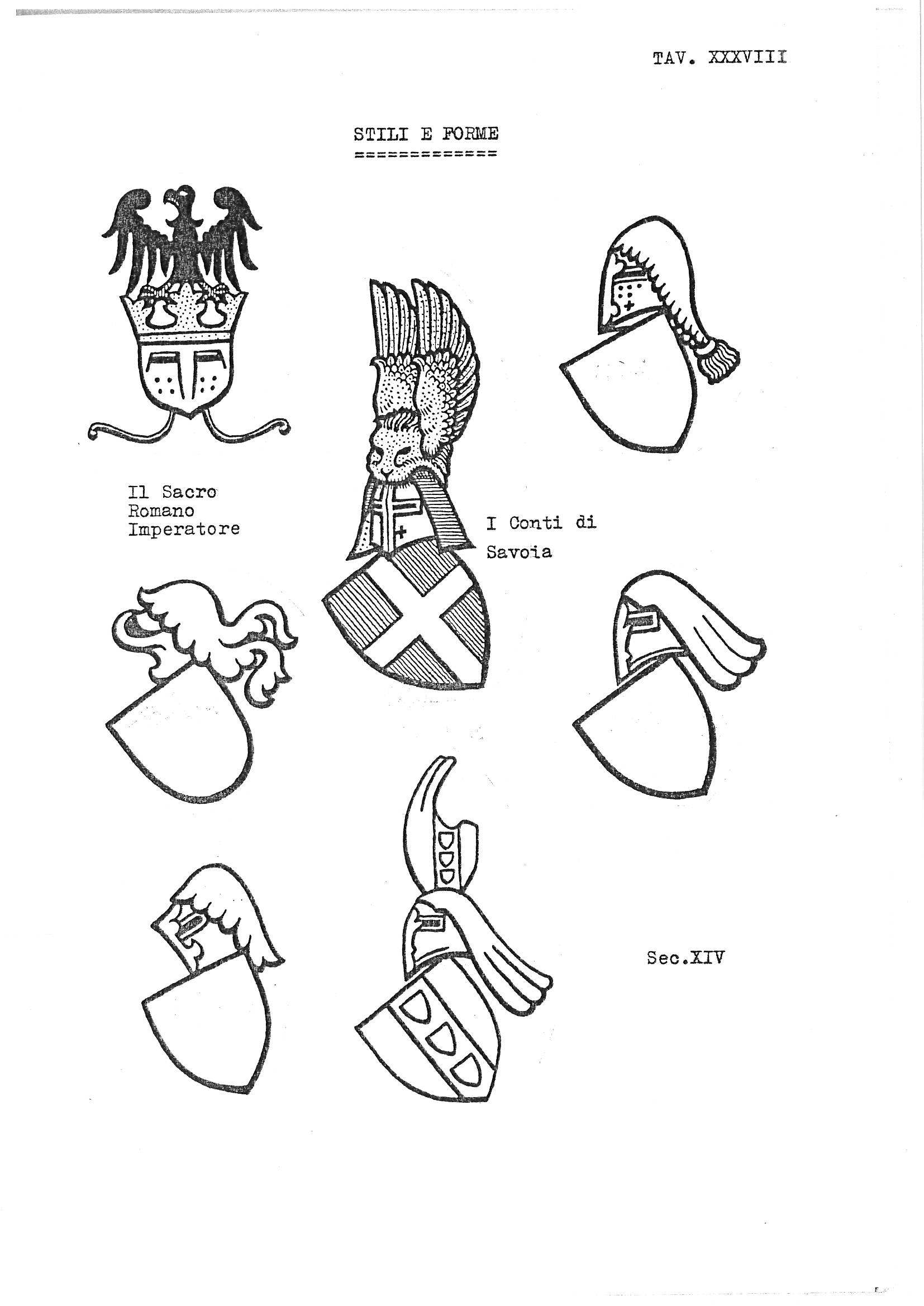
STILI E FORME
=============
Il Sacro
Romano
Imperatore
I Conti di
Savoia
Sec.XIV
---
[PLATE XXXVIII]
STYLES AND FORMS
================
The Holy
Roman
Emperor
The Counts of
Savoy
14th Century
---
TAV. XXXIX
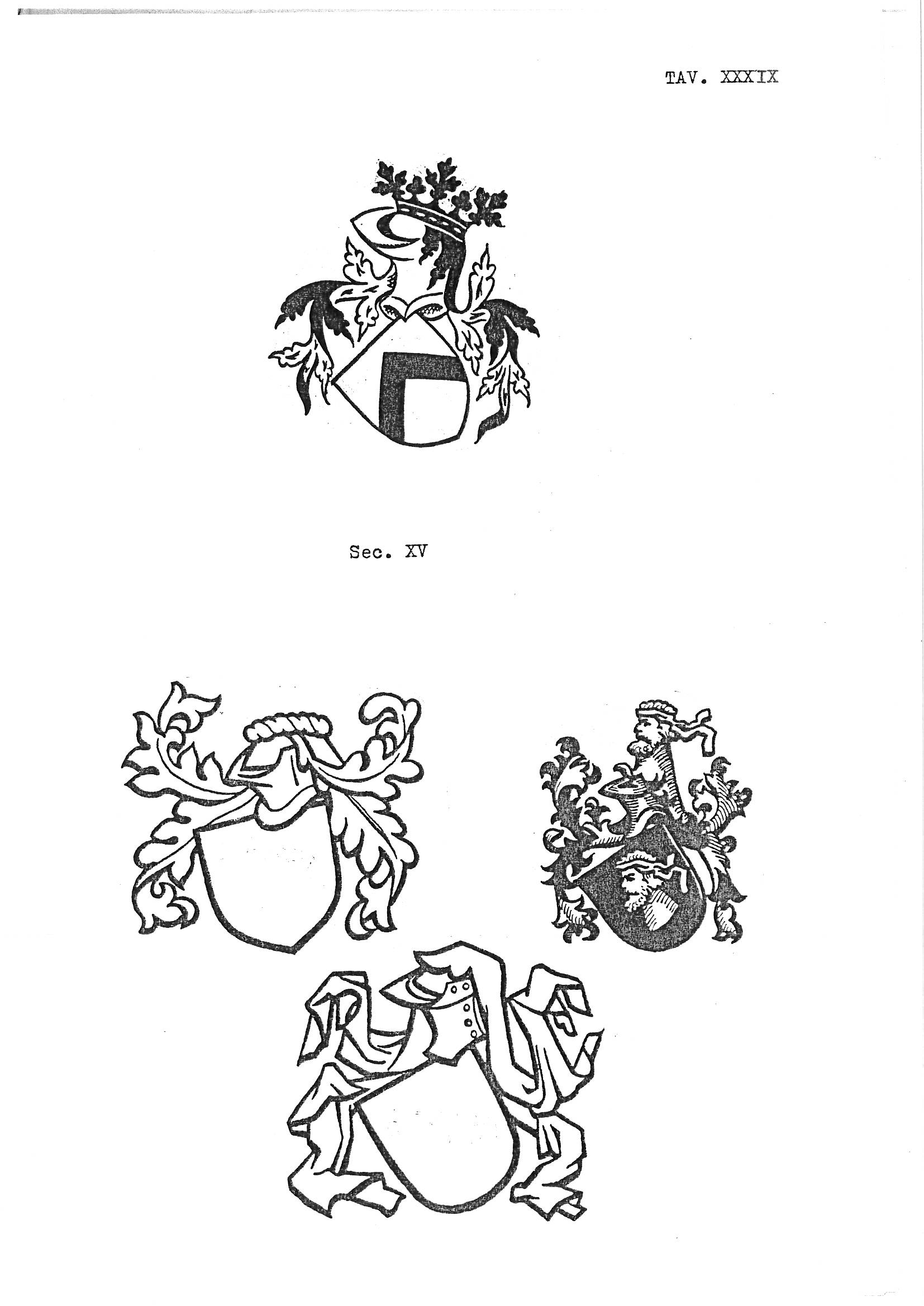
Sec. XV
TABLE XXXIX
15th Century
TAV. XL
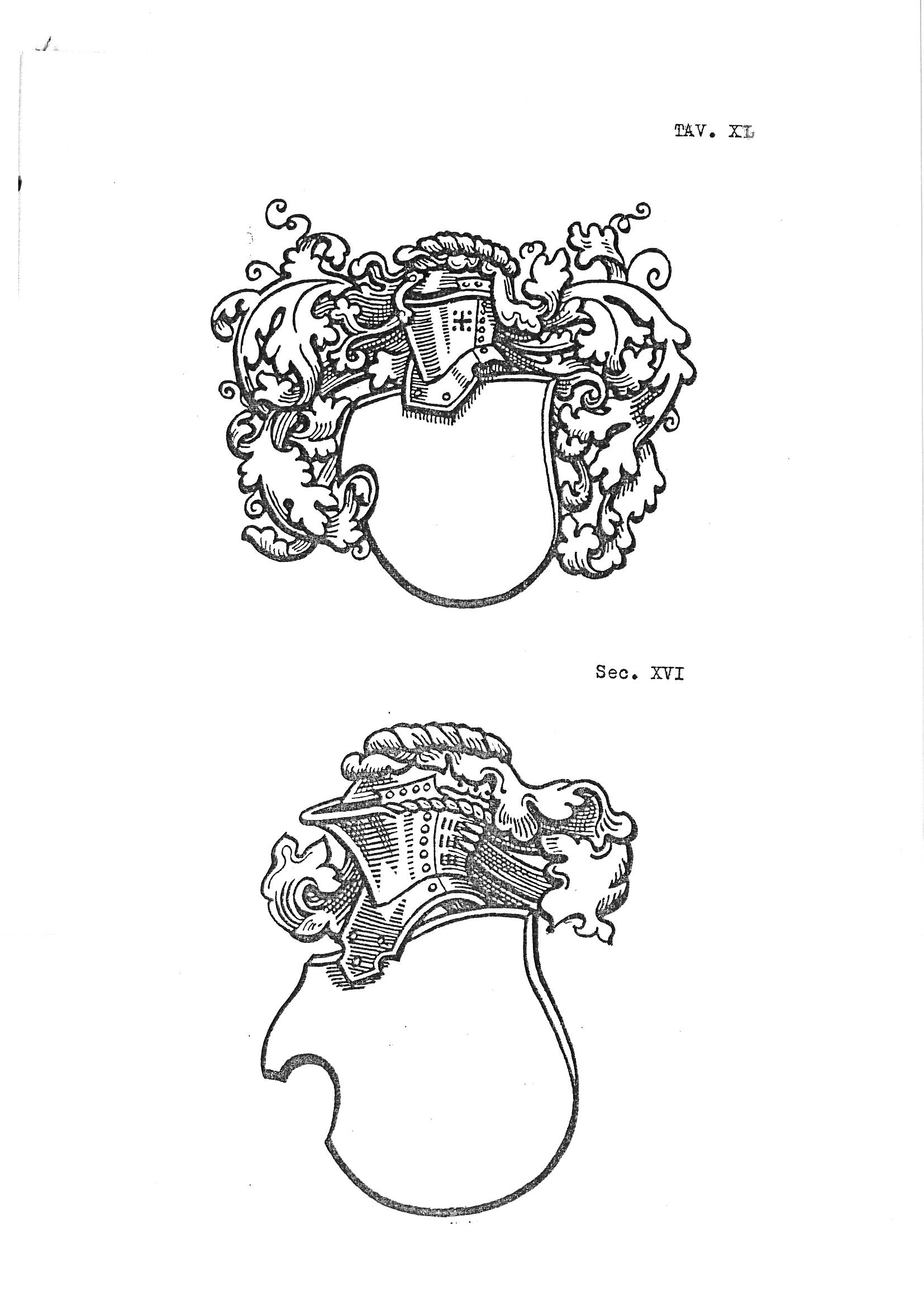
Sec. XVI
# TAV. XL
Sec. XVI
---
*[This appears to be a simple header/title page reference indicating "Table/Plate XL" and "16th Century" - minimal translation needed as these are primarily numerical and chronological designations]*
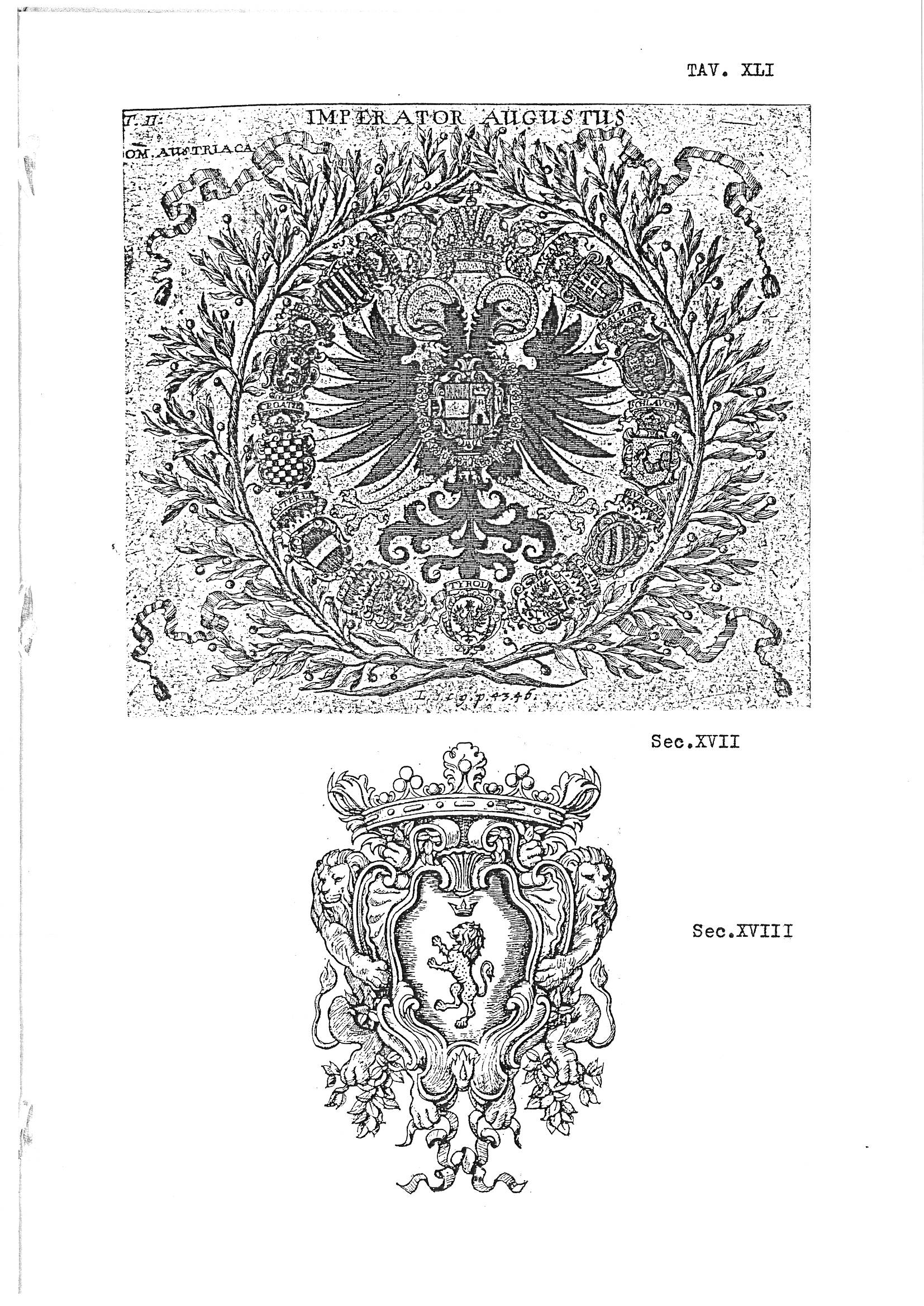
TAV. XLI
T. II. IMPERATOR AUGUSTUS
DOM. AUSTRIACA
TYROL
T. p. 4346.
Sec.XVII
Sec.XVIII
---
TAV. XLI
T. II. IMPERATOR AUGUSTUS
DOM. AUSTRIACA
TYROL
T. p. 4346.
17th Century
18th Century
---